
How to Get Rid of the Pacifier (Gently)
Getting rid of the pacifier means gradually or abruptly removing pacifier access while offering alternative comfort strategies, with most pediatric experts recommending the process begin around 12 to 18 months and be complete by age 3.
Last updated: June 2026
Quick Answer: How to Get Rid of a Pacifier
The gentlest approach is a phased one: start by limiting the pacifier to sleep only, then drop naps, then nights, and pair each step with a comfort object your child already loves. For babies under 12 months, there’s no rush. For toddlers 2 and older, a goodbye ritual or a simple story can make the transition feel like their idea rather than a punishment. Most kids adjust within a week.
You know that moment when you realize the tiny rubber thing that saved your sanity at 3 a.m. has somehow become the boss of your whole household? Your toddler can’t nap without it, can’t fall asleep without it, and is starting to ask for it in the grocery store checkout line. The guilt creeps in. The Googling starts. Every article you find either tells you to rip it off like a bandage or makes you feel like you need a 12-week plan.
The good news: there’s a middle ground, and it’s a lot less dramatic than you’re probably expecting. Here’s what actually works, organized by your child’s age and attachment level.
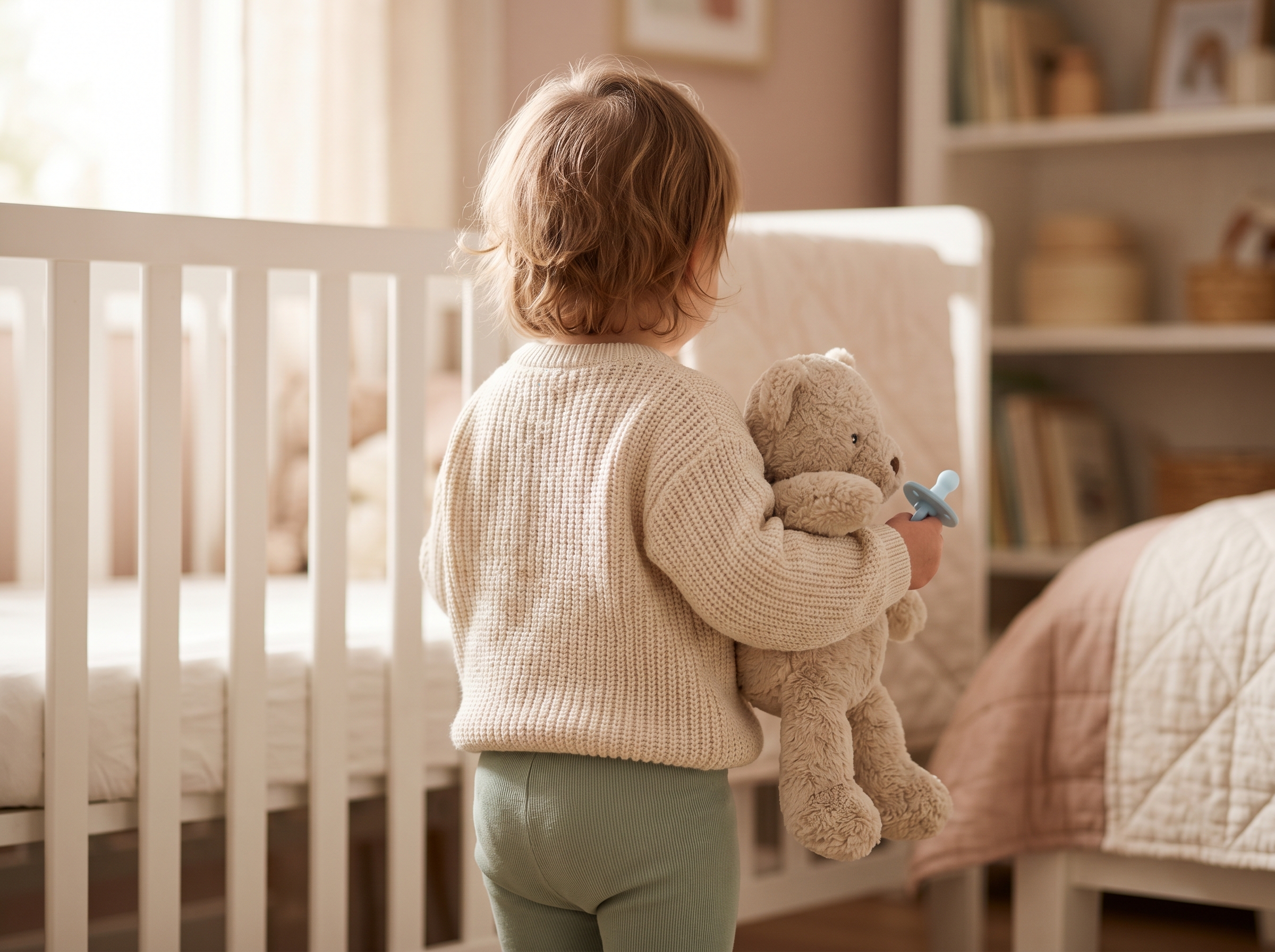
When Should You Actually Get Rid of the Pacifier?
Parents get conflicting advice on this constantly. Your pediatrician says one thing, your dentist says another, and your mom group has seventeen different opinions. Here’s what the actual guidelines say so you can stop second-guessing yourself.
The Expert Age Benchmarks (and Why They Differ)
Different professional organizations focus on different risks, which is why their recommendations don’t perfectly line up.
- AAP and AAFP: Recommend weaning during the second six months of life (around 6 to 12 months) to reduce the risk of otitis media (middle ear infections). Extended pacifier use past infancy is associated with a higher rate of recurrent ear infections.
- American Academy of Pediatric Dentistry (AAPD): Recommends stopping by age 3 to prevent dental development issues.
- AAP safe sleep guidance: Offering a pacifier during sleep in the first 6 to 12 months can help reduce the risk of SIDS. This is exactly why you don’t rush early weaning when a baby is still in that window.
A practical way to think about it: if your child is under 12 months, there’s no urgency. Between 12 and 18 months, start limiting use. By 2 to 3 years, aim to be done. Your child’s one-year dental checkup is a natural moment to ask your pediatric dentist what they’re seeing and what they’d recommend for your kid specifically.
According to the American Academy of Pediatrics, a good first step is simply ignoring the habit, since most children stop on their own without intervention like harsh words or teasing. Worth keeping in mind before you go into full campaign mode.
What Prolonged Use Actually Does (Specifics Most Posts Skip)
You’ve heard “it’ll mess up their teeth” a thousand times. But most articles stop there, which isn’t especially helpful when you’re trying to decide if NOW is the moment to act.
According to James Bekker, DMD, a pediatric dentist at the University of Utah School of Dentistry, the main concern with extended use is an anterior open bite, where the front teeth don’t meet properly, making biting foods difficult. Children using a pacifier at age 3 or older have a higher chance of developing this pattern. Continued use can also lead to a narrowed palate and posterior crossbite, conditions that may require interceptive orthodontics down the road.
The reassuring part: when pacifier use stops, the bite naturally begins to correct itself. The earlier the habit ends, the less intervention is typically needed. Bekker puts it simply: earlier is better, both for the outcome and for reducing the treatment required.
One more distinction worth making. These risks are primarily tied to all-day, around-the-clock pacifier use. A child who uses the pacifier only for sleep is in a different category than one who carries it everywhere all day. That context matters when you’re deciding how urgent this feels.
The Right Method Depends on Your Child’s Age
A 7-month-old doesn’t have the same emotional grip on the pacifier as a 2.5-year-old, so the approach shouldn’t be identical. Here’s how to match your strategy to your child’s stage.
6 to 12 Months: The Easiest Window You Might Be In Right Now
Babies this age don’t yet have strong object permanence around the pacifier. Out of sight does mean out of mind. Start by limiting it to sleep only, then drop naptime use, then nighttime. No explanations needed. Distraction and redirection are enough, and filling their awake time with engaging activities makes the transition almost invisible to them.
12 to 18 Months: The Sweet Spot Before Attachment Deepens
Your child understands more now but can’t fully negotiate yet, which is actually in your favor. Gradual restriction works well here: sleep only for a week or two, then naptime only, then gone. The most important move you can make before any of that happens is introducing a comfort object (a lovey, a small blanket, a stuffed animal) so it’s already familiar when the pacifier disappears. Don’t wait until the paci is gone to introduce it.
2 to 3 Years: When You Need a Plan and Maybe a Story
Strong attachment, language, and memory mean this age group needs a real transition strategy, not just a swap. Kids this age can be involved in the goodbye, which tends to make it go smoother than a surprise removal. Cold turkey can still work at this age, but it goes better with preparation. More on both approaches below.
The Gradual Method, Step by Step
Your toddler asks for the pacifier constantly and you’re not ready to hear three nights of crying. Gradual doesn’t mean forever. It means strategic and consistent, moving through phases rather than dragging it out indefinitely.
Step 1: Location Limits First
The pacifier stays in the crib or the car only. It doesn’t travel from room to room anymore. Hold this boundary for one to two weeks before moving to the next step. It sounds small, but it resets the pattern of constant access.
Step 2: Sleep Only
Once location limits feel normal, restrict the pacifier to naps and nighttime only. If your toddler asks for it during the day, try: “The pacifier is sleeping right now.” That framing is age-appropriate, doesn’t make a big production of it, and holds the boundary without a confrontation. Give this phase another one to two weeks before moving on.
Step 3: Drop Naptime, Then Nights
Naptime use typically goes more easily than nighttime, so drop that first. Give it five to seven days before tackling overnight. Have the replacement comfort object ready before each phase shift, not after. Being consistent within each phase matters far more than moving quickly. One backslide doesn’t ruin everything, but a pattern of backsliding does reset the message for your child.
How to Get Rid of the Pacifier for Sleep
Daytime is manageable. It’s the 2 a.m. scream for the pacifier that’s breaking everyone. Sleep weaning is its own challenge because the pacifier isn’t just comfort at that hour. It’s a sleep association, and those are harder to untangle.
Here’s what’s actually happening: your child falls asleep with the pacifier in their mouth, wakes naturally at the end of a sleep cycle (which all humans do), and can’t resettle without it because it was part of how they fell asleep to begin with. Then they call for you. You replace it. The cycle repeats. The pacifier isn’t the villain here. The dependency on it as the bridge back to sleep is.
Three strategies that actually help:
- The multi-paci crib trick: For babies who can find and replace their own pacifier, place three or four of them around the crib before bed. More chances to self-locate at 2 a.m. means fewer calls for you. This works particularly well for the 8-to-18-month range before you begin full weaning.
- Pre-weaning the sleep association: Introduce a comfort object (lovey, small blanket) into the bedtime routine two weeks before removing the pacifier. By the time the paci is gone, the lovey is already familiar and comforting at sleep time.
- Adjust the bedtime routine: Add a calming step to fill the comfort gap. An extra song, a longer back rub, a few minutes of quiet book reading. The goal is giving your child a longer runway to feel settled before you leave the room.
Realistic timeline: most children adjust to sleeping without a pacifier within three to seven nights. The first two nights are the hardest. Night four tends to be a turning point for most kids, with significant improvement by the end of the first week.
When Cold Turkey Is Actually the Gentler Choice
Gradual withdrawal works well for many families, but it can also drag out the confusion for some kids. A prolonged process means more days of “will I get it or not?” which creates its own kind of stress. Cold turkey can be the kinder option in certain situations.
It tends to work best when your child is under 12 months (no explanation needed, just removal) or when your child is 2.5 or older and can understand a simple goodbye narrative. For toddlers, give 24 to 48 hours of honest, low-key warning: “After today, we’re saying goodbye to the pacifier.” Keep it short. Don’t over-explain or over-celebrate it with “you’re such a big kid!” because if they don’t feel like a big kid at 2 a.m., that framing can backfire.
Throw every pacifier away at the same time. Having a backup in the junk drawer is how the whole thing falls apart on night two.
Make It a Moment: Goodbye Rituals That Actually Help Toddlers Let Go
Toddlers thrive on narrative and ceremony. Giving the pacifier goodbye a story can flip it from something being taken away to something they’re a part of. That shift in agency makes a real difference.
The Pacifier Fairy (or Mail Carrier, or Build-a-Bear)
The pacifier fairy visits at night and leaves a small gift, framed around giving the pacifier to babies who need it now. It’s gentle and it gives the child a role in the story. The Build-a-Bear variation lets your child stuff the pacifier inside the animal before it’s sewn up, so it’s “still there” in a new form. Some families do a ceremonial mailing: draw a picture, put the pacifier in an envelope, walk it to the mailbox together. The ritual itself is the point.
Pacifier Books Worth Reading Together First
Read one of these for one to two weeks before the actual goodbye so the concept already feels familiar when the day arrives:
- Bye-Bye Binky by Brigitte Weninger: A warm, simple story about saying goodbye to the paci with confidence.
- Bea Gives Up Her Pacifier: A board book-format option for younger toddlers who can’t sit for longer stories yet.
- My Bye-Bye Binky (Let’s Talk About It series): Slightly more narrative, good for kids 2.5 and up who can engage with a longer storyline.
Let Them “Give” It Away
Toddlers who feel like they chose to give the pacifier away (to “babies at the hospital” or tied to a “paci tree” at the park) experience agency instead of loss. That reframe is powerful. You’re not taking something. They’re giving something. It’s a small shift in language with a big impact on how the whole thing lands.
When They Ask for It Back (Because They Will)
It’s day three. The pacifier is gone. Your toddler is tearfully asking for it at bedtime and you’re this close to caving. Here’s what to do instead.
Start by validating without dismissing: “I know you miss it. It was really cozy.” Being heard reduces meltdown intensity more than distraction does. Then immediately redirect to the comfort object. The lovey, the stuffed animal, the blanket. Whatever you’ve been building up as the replacement. Have it ready in your hand before you even walk into the room.
Hold the line on language. “The pacifier is all gone” said calmly and consistently closes the negotiation. The moment you say “maybe later” or “just this once,” the asking doubles because now there’s a chance. Your toddler is not manipulating you. They’re just following the logic of what’s worked before.
If a major life stressor hits right after you’ve removed the pacifier (a new sibling, a move, an illness), it’s okay to acknowledge that everything feels hard right now. Lean into extra connection at bedtime: more snuggles, longer routines, your physical presence as the comfort tool. That’s not the same as reinstating the pacifier. You can hold space for the hard feelings without going backward.
Night four is usually when the tide turns. By the end of the first week, most kids have landed in a new normal and stopped asking regularly. You’ll get there.
Frequently Asked Questions
What age should you take away the pacifier?
Most pediatric experts suggest beginning to limit pacifier use around 12 to 18 months and completing the process by age 3. The AAP recommends weaning during the second six months of life (around 6 to 12 months) to lower the risk of ear infections, while the AAPD recommends stopping by age 3 to protect dental development. That said, your child’s individual attachment and your family’s readiness are real factors. There’s no single date that works for every kid.
How do I get rid of a pacifier without a lot of crying?
The gradual approach tends to minimize tears: restrict use to sleep only for one to two weeks, then drop naptime, then nights. Pair each phase with a comfort object your child already loves before the paci disappears. The more familiar and comforting the replacement item is, the smoother the transition tends to go. Crying will likely still happen, but it’s usually shorter-lived than parents expect.
How do I get my child to sleep without a pacifier?
Introduce a lovey or comfort object into the sleep routine at least two weeks before removing the pacifier so it’s already familiar when the paci is gone. Add a calming step to your bedtime routine to give your child a longer runway for settling down. The first two to three nights are the hardest, with most children showing real improvement by night four or five.
Is it okay to get rid of the pacifier at 6 months?
Yes, 6 to 12 months is actually the easiest window for weaning because babies this age don’t yet have a strong narrative attachment to the pacifier. Distraction and redirection work well, and object permanence isn’t fully developed yet. The one thing to keep in mind: if you’re still using the pacifier as part of a safe sleep routine at night, check in with your pediatrician before removing it entirely in those early months.
What do I do if my toddler keeps asking for the pacifier after it’s gone?
Stay calm and consistent: “The pacifier is all gone” plus an immediate redirect to the comfort object. Validate the feeling first (“I know you miss it”), then move on without lingering in the negotiation. Most toddlers stop asking regularly within five to seven days. Offering “just this once” resets the clock and tells your child the asking is worth continuing.


