
The Working Mom Survival Guide
Working mom tips are practical strategies for managing your schedule, reducing guilt, preventing burnout, and protecting your energy so you can show up for both work and family.
Last updated: July 2026
Quick Answer: Working Mom Tips That Actually Work
The most effective working mom tips don’t ask you to do more. They ask you to do things differently. Protect two non-negotiable anchors in your day, name the guilt instead of swallowing it, catch burnout before it flattens you, and stop saying yes to obligations that were never yours to carry. This guide covers all of it, without pretending you have a spare hour hiding somewhere.
If you’ve ever found yourself answering a Slack message while packing a lunchbox, only to realize you can’t remember if you hugged your kid goodbye that morning, this one’s for you. Not written from a boardroom or a wellness retreat. Written from the trenches, where the coffee is reheated and the to-do list never fully clears.
We’re covering the schedule, the guilt, the burnout, and the specific hacks that actually move the needle. All in one place, so you don’t have to go looking for it at 11pm when you finally have five minutes to yourself.
And if you’re looking for ways to get dinner handled faster on weeknights, these kid-friendly dinner ideas for busy nights are a good starting point for getting that piece off your plate.
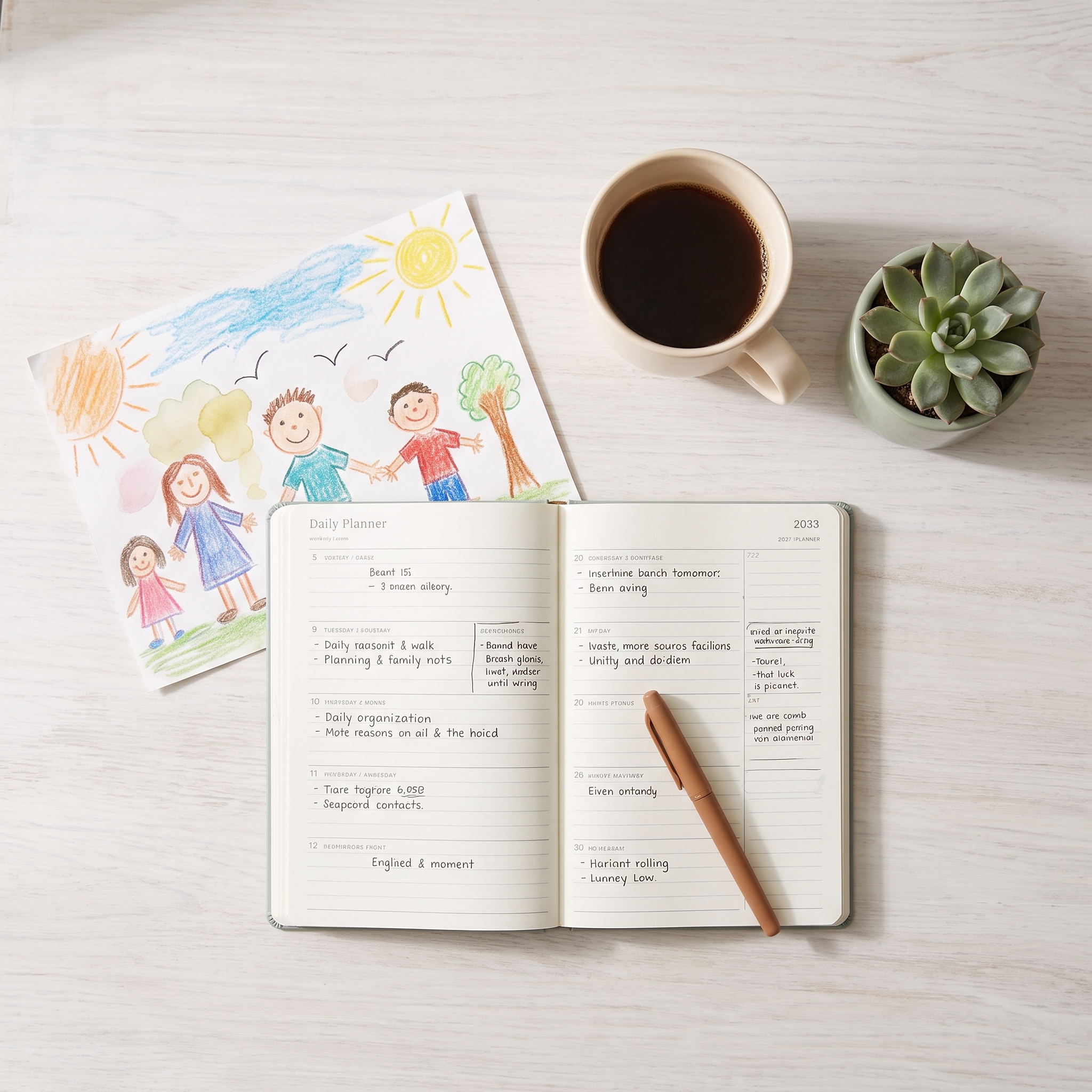
You’re Not Failing, Here’s What Working Moms Are Actually Up Against
Before any tips land, this needs to be said: the standard you’re being held to isn’t realistic. It was never realistic. And knowing that changes how you read everything else in this guide.
The Numbers Are Real (And Not in Your Favor)
According to Bureau of Labor Statistics American Time Use Survey data, employed mothers spend significantly more time on childcare and household tasks each day than employed fathers. Pew Research data shows a large share of working mothers say their career advancement has taken a hit specifically because they’re parents.
The working mom vs. stay at home mom comparison gets a lot of airtime, and I’d rather shut it down fast: both are hard. Both involve sacrifice. Both come with guilt in different flavors. The real opponent here isn’t another mom’s choice. It’s the impossible standard that tells you you’re never doing enough, no matter which path you’re on.
Name that standard for what it is, and you stop fighting yourself. That’s the foundation everything else builds on. If you want to go deeper on the research behind what working moms actually model for their kids, this piece on the real advantages of being a working mom covers it well.
Build a Working Mom Schedule That Actually Holds Up
The schedule that looks beautiful on Sunday night and falls apart by Tuesday morning? We’ve all been there. The problem usually isn’t discipline. It’s that the schedule was built on ideal conditions, not real ones.
Anchor Your Day With Two Non-Negotiables (Not Ten)
Pick one morning anchor and one evening anchor, and protect them. Everything else bends around those two. A morning anchor might be a 15-minute family breakfast where phones stay away from the table. An evening anchor might be a 20-minute device-free wind-down with your kids before bed.
Research suggests adults make tens of thousands of decisions per day. Anchors eliminate a chunk of those by making certain moments automatic. You don’t decide whether to do them. They just happen.
The Transition Ritual Most People Skip
This one matters whether you work outside the home or from your kitchen table. You need a 5 to 10 minute ritual that signals the shift from “work brain” to “mom brain.” A short walk around the block. Changing out of work clothes. A specific playlist. Three deep breaths and your phone in a drawer.
A UC Irvine study found that context-switching can cost up to 23 minutes of refocus time. A consistent transition ritual short-circuits that. You’re not wasting time on the ritual. You’re buying back the time you’d otherwise spend mentally still at your desk while your kid is trying to tell you about their day.
Time-Block Like a Mom, Not Like a Productivity Guru
Pomodoro-style sprints (25 minutes on, 5 minutes off) work well in theory. In mom-life practice, adapt them. Batch similar tasks: emails in one window, calls in another, anything requiring deep focus during the stretch when your kids are most settled or at school.
On grocery delivery: if your hourly rate at work is $25 or more, and a grocery run eats 90 minutes of your day, a $10 delivery fee is straightforward math. Paying for time back isn’t a luxury. It’s resource management.

Working Mom Guilt Is Real, Here’s How to Stop Letting It Drive
I’m not going to tell you working mom guilt isn’t real. It’s very real. What I will say is that guilt and truth are not the same thing, and they’re worth separating.
What Working Mom Guilt Actually Is (and What It Isn’t)
Guilt is the belief that you’re causing harm. But a Harvard Business School study found that daughters of working mothers go on to earn more and hold supervisory roles at higher rates than daughters of non-working mothers. The data doesn’t support the guilt narrative.
The American Academy of Pediatrics is consistent on this: what matters most to children’s development is the quality of the parent-child interaction, not the total number of hours logged. Working mom guilt often shows up as a feelings problem dressed up as a facts problem.
Reframe it this way: guilt isn’t a signal that you’re failing. It’s a signal that you care. That’s different.
The “Good Enough” Standard (Borrowed From Pediatric Psychology)
Pediatric psychologist Donald Winnicott coined the phrase “good enough mother” decades ago. The idea, in plain-mom language: your child doesn’t need a perfect parent. They need a consistently present one who repairs things when they go sideways.
When you miss a moment, you name it. “I was distracted this morning and I missed saying a real goodbye. I’m sorry.” That repair is the parenting. It’s not a consolation prize. It’s the actual work.
When working mom guilt flares up, I run a two-question gut check: Did my kid feel loved today? Did I show up for at least one real moment? If the answer to both is yes, the guilt doesn’t get to keep talking.
When Tired Becomes Burnout, Catch It Before It Catches You
There’s a version of exhaustion that working moms normalize for so long they stop recognizing it as a problem. If you’ve been running on empty for months and calling it “just a hard season,” this section is for you.
Three Signs You’re in Burnout, Not Just a Hard Week
The World Health Organization classifies burnout as an occupational phenomenon with three core markers: exhaustion, cynicism or detachment, and reduced effectiveness. In mom-life terms: you resent the things you used to love, you feel nothing during moments that should feel good, and you’re getting sick constantly because your body is finally saying what your schedule wouldn’t.
Working mom burnout carries a second layer that regular burnout doesn’t. Work burnout hits your professional identity. Working mom burnout also hits your identity as a mother. Recovery has to address both pieces, not just the job side.
Five Micro-Recovery Habits That Don’t Require a Spa Day
Even just five minutes of a consistent daily self-care ritual can meaningfully reduce stress. Five minutes. That’s an achievable bar.
- One minute of quiet before your feet hit the floor: eyes closed, no phone, just a breath. Motherly highlights this as one of the highest-impact low-effort habits for working moms.
- A 10-minute walk outside: natural light resets your cortisol rhythm in a way that a second cup of coffee simply doesn’t.
- One real social touchpoint per week with another woman: not a playdate, not a school event. Something for you.
- A hard cutoff time for work communications: no Slack, no email after a set hour. Name it to your team so it’s not a secret.
- Sleep as a non-negotiable: the CDC recommends 7 or more hours of sleep a night for most adults. Chronic undersleeping slows reaction time and raises emotional reactivity. You’re not tougher for sleeping less. You’re just slower and shorter-tempered.
For those days when you have 5 minutes and nothing else, these 5-minute workouts for busy moms are built around exactly that reality.

Practical Working Mom Hacks That Are Actually Specific
“Delegate more” and “ask for help” are the advice equivalent of telling someone to “just relax.” Technically accurate. Completely unhelpful without the how.
At Home, Reduce the Mental Load, Not Just the Task Load
The mental load is the invisible project management of family life: remembering the dentist appointment, knowing the school form deadline, tracking what’s running low in the pantry. Tasks can be delegated. Mental load has to be offloaded through systems.
A weekly Sunday brain dump helps. Ten minutes, everything in your head goes on paper: appointments, school forms, errands, things you’re low-grade worried about. Once it’s on paper, it’s not spinning in your brain at 2am.
Kids as young as 3 to 4 years old can handle simple household contributions, things like sorting laundry, setting the table, or putting shoes in the right spot. This isn’t just about getting tasks done. It builds their sense of capability and takes items off your list simultaneously.
Keep five “no-think” default dinners in rotation. When your decision-making bandwidth is depleted, you don’t have to decide what’s for dinner. It’s just Tuesday, and Tuesday is pasta night.
At Work, Protect Your Time Like It’s Your Paycheck
There’s what I’d call a “working mom tax” in most workplaces: the invisible time debt created by every absorbed yes. Someone else’s urgent request becomes your afternoon. A meeting that didn’t need you still has you in it.
Audit your yeses once a quarter. Which meetings, projects, and obligations are yours by role? Which ones landed on your plate because you’re available, agreeable, or just haven’t said no yet? That distinction is worth finding.
Set a visible hard stop time with your team and name it plainly: “I pick up my kids at 5, so I’m offline after 4:45.” Most colleagues respect a boundary that’s stated clearly more than one that’s quietly hoped for.
Template your most-repeated communications. School emails, work update messages, appointment request replies. Ten solid templates can save you close to 30 minutes a week, and that time compounds.
FAQ, Working Mom Questions, Answered Straight
How do I be less stressed as a working mom?
Start by identifying your single biggest friction point: is it the schedule, the guilt, or the support gap? Make one change in that area before trying to fix everything at once. Stress compounds when every problem feels equally urgent and equally unsolvable. Prioritize one thing, move it, then move to the next.
What do working moms struggle with the most?
Research consistently points to the guilt-productivity loop. You feel guilty at work for not being home. You feel guilty at home for thinking about work. The cycle is exhausting because there’s no winning position inside it. Naming the loop is the first step to stepping out of it. The guilt section above covers the practical tools for doing that.
Is working mom burnout different from regular burnout?
Yes. Work burnout hits your professional identity: your drive, your focus, your sense of purpose at the job. Working mom burnout hits that, plus your identity as a mother. You can feel like you’re failing at both simultaneously, which makes recovery harder. Getting better requires addressing the mom piece and the work piece, not just taking a long weekend.
How do I stop comparing myself to stay-at-home moms?
The comparison is a distraction from your actual life. Both paths are hard in different ways, and neither one is a shortcut. Your kids need a present, sane parent more than they need one who’s stretched to the breaking point trying to look like someone else. The Harvard data mentioned in the guilt section above is worth coming back to when the comparison gets loud.
What’s a realistic working mom morning routine?
Wake 30 to 45 minutes before your kids. Use that time for one quiet anchor moment, not a full self-improvement regimen. Prep as much as possible the night before: clothes laid out, bags by the door, lunches in the fridge. Give yourself permission for a 20-minute morning routine instead of a 90-minute one. The goal is calm and out the door, not Pinterest-perfect.


