
The Real Advantages of Being a Working Mom
The advantages of being a working mom include raising higher-earning, more independent children while building your own financial security, identity, and mental well-being.
Last updated: June 2026
Quick Answer: Advantages of Being a Working Mom
The research is consistent: working moms raise kids who go on to earn more, take on more responsibility at home, and develop stronger views on equality. At the same time, moms who work outside the home report better mental health, a stronger sense of self, and more financial resilience. The advantages of being a working mom touch every corner of family life, not just your paycheck.
If you’re reading this at 6:47 AM, half-dressed, coffee in hand, wondering whether choosing to work makes you a lesser mom, this article is for you. We’re going to cover the research that counters the guilt, the benefits your kids are quietly absorbing, and the small everyday perks that nobody talks about out loud but every working mom feels. All of it counts.

The Working Mom Guilt Is Real, And So Is the Science That Counters It
Let’s name it: working mom guilt is exhausting. It shows up in the school pickup line, in your inbox at 3 PM, and sometimes at 2 AM when you can’t sleep. Nobody should tell you it isn’t real, because it is.
What’s also real is that the research doesn’t back it up. A 2010 American Psychological Association meta-analysis found no significant behavioral, social, or learning issues in children raised by working moms. Kids were on track academically. The guilt, it turns out, is often rooted in cultural messaging rather than actual evidence of harm.
You’re also far from alone. According to the U.S. Bureau of Labor Statistics, about 74% of mothers with children under 18 were in the labor force as of 2025. This isn’t a fringe choice. It’s the norm. The next time the guilt creeps in, remind yourself: you’re not the exception. You’re the majority.
You’re Raising Kids Who Will Outperform in Ways You Can Measure
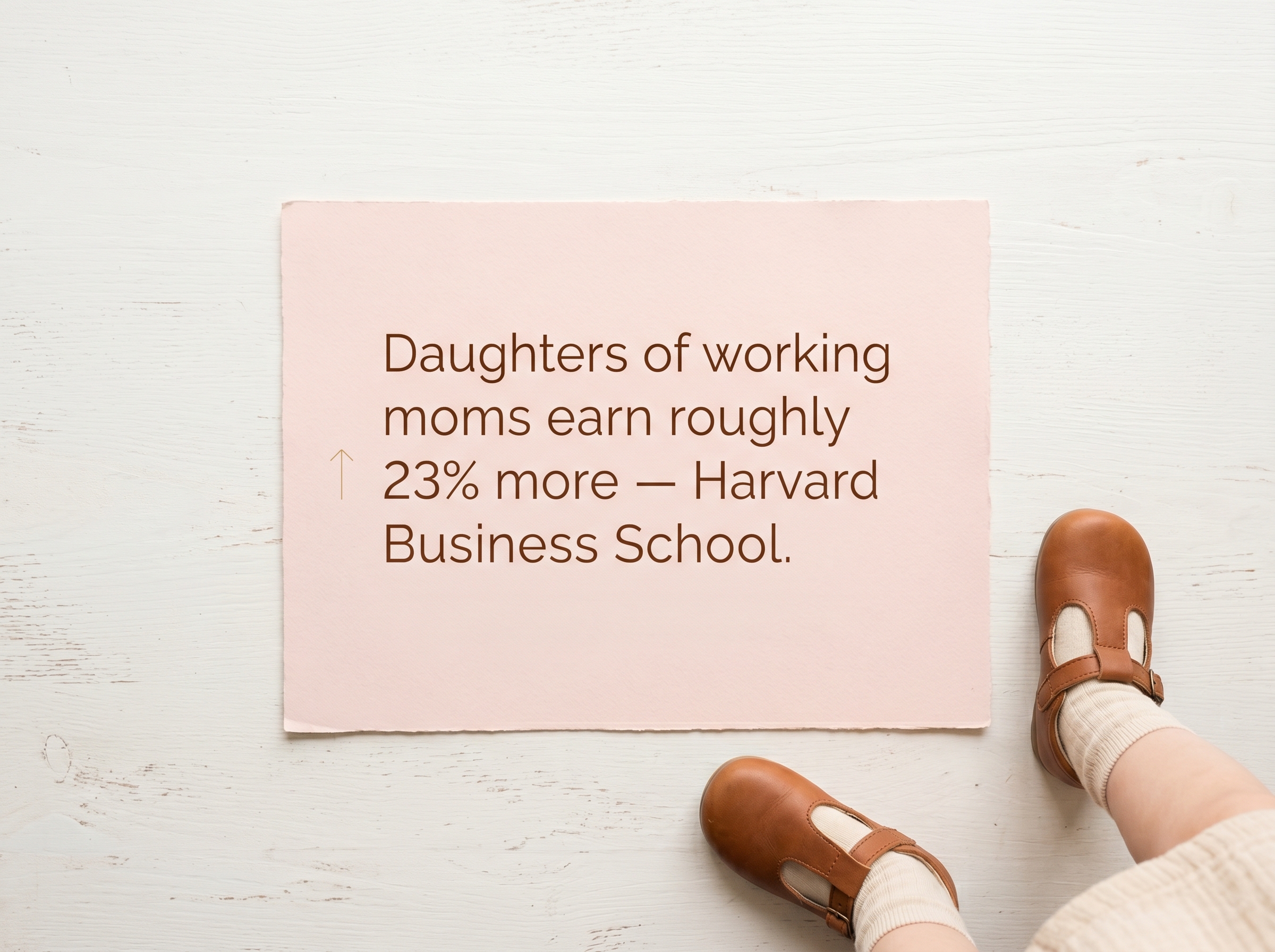
This is the section to screenshot and save for the hard days. A 2015 Harvard Business School study found that daughters of working moms are more likely to be employed, more likely to hold supervisory roles, and earn roughly 23% more than daughters of stay-at-home moms, according to the study.
Harvard researcher Kathleen L. McGinn, who co-led the study, described the effect as one of the clearest drivers of gender equality we know of, with direct, measurable impacts across the board. That’s not motivational poster language. That’s data.
Sons benefit too. Research from the same study shows that men raised by working moms are more likely to share household responsibilities and participate in childcare as adults, making them more equitable partners down the line.
And for anyone worried about cognitive development: research published in the journal Child Development found that working moms had no negative impact on children’s reasoning skills or vocabularies. The working mom benefits here aren’t abstract. They follow your kids into their adult lives.
When you go to work, you’re not leaving your kids behind. You’re giving them a head start.
The Skills You’re Building at Work Are Making You a Better Mom at Home
Amy Henderson, founder of Tend Lab, interviewed more than 200 high-performing working parents and found something most of them hadn’t expected: the majority were performing better at work because of motherhood, not despite it. The positives of being a working mother run in both directions.
Work builds skills that transfer straight back to your home life. Here are five that show up in your parenting whether you realize it or not:
- Emotional intelligence: working through a difficult client meeting and a toddler meltdown require the exact same read-the-room patience. You’re practicing both.
- Resilience: Bouncing back from a bad quarterly review and a parenting fail both use the same muscle. Yours is getting stronger.
- Productivity and efficiency: A mom who works knows how to make 45 minutes count in ways most people simply don’t, and that same systems thinking often carries over to keeping the household running smoothly.
- Courage: Making hard calls at work models decision-making and risk-taking for your kids in a way that sticks.
- Ambition and motivation: Your kids see a parent with goals. That’s contagious in the best possible way.
You probably already know this, even if nobody’s said it out loud. The job and the parenting aren’t competing. They’re building each other.
Working Gives You Something That Benefits Your Whole Family, Not Just Your Career
A 2012 study in the Journal of Health and Social Behavior found that mothers who worked full-time and continuously after their first child reported better physical and mental health at age 40 than mothers who worked part-time, had interrupted employment, or stayed home. That’s not a small finding. That’s your future self, doing better.
Having a professional identity, adult conversations, and daily accomplishments that exist completely outside of caregiving creates a more emotionally available mom when you are home. It’s not about escaping your family. It’s about having something to pour from.
Financially, the working mom benefits extend to every member of your household. A second income builds emergency funds, college savings, and retirement security. It’s a cushion against layoffs, a layer of protection the family wouldn’t otherwise have. That’s a gift to your kids, even if it’s invisible to them right now. If you want to protect your own energy too, building in a 5-minute workout routine on the busiest days can make a bigger difference than it sounds.
Your Kids Are Watching You Be Financially Independent
This angle rarely gets talked about, and it should. When your kids watch you earn, budget, negotiate, and build a professional life, they grow up with a completely different relationship to money and self-sufficiency, especially your daughters.
That roughly 23% wage advantage documented in the Harvard research isn’t random. It’s modeled behavior, passed down from a mom who showed up, put in the work, and demonstrated what financial independence looks like from the inside.
Your sons are absorbing this too. Boys raised by working moms grow up understanding that women are full economic contributors. That shapes how they treat partners, how they split finances, and how they’ll raise their own kids someday. You’re not just working for yourself. You’re working for the generation after this one.
What that independence looks like on paper differs by country. In the Netherlands, for example, employees receive a holiday allowance of at least 8% of their gross pay, usually paid out in May, and it is taxed at a special rate that often surprises people; Infobak’s guide to tax on holiday pay (in Dutch) shows how much of it you actually keep.

The Quality-Over-Quantity Research Is on Your Side
“You’re missing their childhood.” If you’ve heard that one, here’s what the research says. A 2015 study in the Journal of Marriage and Family by Milkie, Nomaguchi, and Denny found that the amount of time mothers spent with children ages 3 to 11 had virtually no measurable effect on children’s emotional well-being, behavior, or academic achievement.
What did matter was engaged time: reading together, sharing meals, one-on-one conversation. The kind of time you can absolutely have on a weeknight or a Saturday morning.
Working moms often bring more focused, intentional presence to evenings and weekends because that time is finite. There’s no scrolling through the afternoon with half your attention somewhere else. You’re there, and you know it matters. Something as simple as a heartfelt note tucked into a lunchbox counts more than an hour of distracted togetherness. It’s not about logging hours. It’s about being present in the ones you have.
The Everyday Perks Are Real and You’re Allowed to Appreciate Them
Okay, a breath of fresh air after all the data. The pros of being a working mom include some things nobody puts in a research paper but every working mom privately appreciates:
- A hot lunch eaten while it’s still hot.
- Adult conversations that don’t involve negotiating screen time.
- A sense of daily accomplishment that has nothing to do with the laundry pile.
- Sick days that are actually for recovering.
- A reason to own something with a zipper.
None of that means you’re escaping your kids. It means you’re recharging so you come back better. That’s not guilt-worthy. That’s smart parenting.
Frequently Asked Questions About Being a Working Mom
What are the main benefits of being a working mom?
The benefits span your whole family. Working moms report better mental health and a stronger sense of identity, while the financial security of a second income protects everyone. Research from Harvard Business School shows that children of working moms, especially daughters, go on to earn more and advance further in their careers. The advantages of being a working mom are personal, financial, and generational all at once.
Does being a working mom negatively affect children?
The research consistently says no. A 2010 APA meta-analysis found no significant behavioral, social, or learning issues in children of working moms, and they were on track academically. Research in Child Development confirmed no negative impact on reasoning skills or vocabulary development. The fear that working harms kids isn’t supported by the evidence.
How do I deal with working mom guilt?
Start by recognizing that the guilt usually comes from cultural messaging, not from anything you’ve done wrong. The data shows your kids are okay, more than okay, in fact. Reminding yourself of the concrete benefits you’re providing, including financial security, role modeling, and your own mental health, can help reframe guilt into something closer to perspective. You don’t have to earn the right to work.
What benefits am I entitled to as a working mom in the US?
This article covers the personal and parenting advantages of working. For legal and workplace entitlements, including FMLA leave, lactation break laws, and state-level protections, the U.S. Department of Labor is the most reliable starting point. Your HR department or an employment attorney can walk through what applies to your specific situation.
Is it better for kids to have a working mom or a stay-at-home mom?
Research doesn’t support a blanket answer either way, and this article isn’t here to start that argument. What the studies consistently show is that it’s less about employment status and more about engaged, quality time and financial stability at home. Kids thrive with present, loving parents regardless of work arrangements. The best choice is the one that works for your family without sacrificing your well-being entirely.


