
Sweet Love Messages for Kids to Brighten Their Day
Love messages for kids are short, heartfelt phrases a parent says, writes, or texts to remind a child they are seen, valued, and unconditionally loved.
Last updated: June 2026
Quick Answer: Love Messages for Kids
Love messages for kids work across every format, from a sticky note folded into a backpack pocket to three quiet words at bedtime. They don’t need to be long or poetic. They just need to be consistent. Used daily, these small gestures build emotional security and reinforce a child’s sense of self-worth in a way that sticks long after the moment has passed.
Here’s the thing about parenthood: some days I’m basically a logistics coordinator with a snack bag. Schedules, reminders, permission slips, dinner. And somewhere in the middle of all of that, I look up and realize the most meaningful thing I said to my kid all day was “put your shoes on.” That’s the moment I reach for a note card.
The good news is that you don’t have to be a poet. You just have to say it. And I’ve got the words right here.
Why a Few Words Can Change Everything for Your Child
Encouraging words for children aren’t a parenting extra. They’re a basic need. According to HealthyChildren.org (American Academy of Pediatrics), safe and nurturing relationships, specific praise, and open communication help children feel secure and build the foundation for healthy emotional development. That kind of consistent affirmation strengthens emotional bonds and builds resilience over time.
Child development research consistently points to verbal affirmation as a pillar of healthy attachment. Kids who regularly hear warm, specific words from their parents tend to develop stronger self-esteem and better emotional regulation as they grow. It’s not magic. It’s just repetition.
I’m not here to guilt-trip you. I’m here with the actual words, ready for you to copy and use today. There are five key daily moments where love messages hit differently, and we’re about to go through all of them.
When Your Kid Needs to Hear It Most
Love messages for kids aren’t just for Valentine’s Day cards or birthday notes. The moments that matter most are usually the ordinary, unremarkable ones happening on a Tuesday.
Monday Morning Nerves
The Sunday-night spiral is real, and it doesn’t just hit adults. Try: “Whatever happens today, I’m proud of you before it even starts.” It works because it removes the pressure of performance. Your child doesn’t have to earn anything. They already have your love, unconditionally, before the week even gets going.
After a Hard Day at School
When a kid walks in the door quiet, or crying, or just off, the instinct is to fix it. But sometimes the most powerful thing is: “You don’t have to tell me anything. I’m just glad you’re home.” Sweet messages for kids don’t have to be long to land. Sometimes six words are enough. And on the days when “off” turns out to be a bug coming on, a note like this pairs well with the rest of your sick-day comfort routine.
When Siblings Are Fighting (and Everyone’s Frustrated)
This one’s tricky, because you’re exhausted too. But there’s a difference between “I love you no matter what” said as a reflex and a message that separates the behavior from the person. Try: “What just happened doesn’t change how much I love you. We’ll work through it.” Specificity matters here. Kids can tell when love is conditional on their behavior, and the goal is to make sure they never doubt it.
Before a Big Moment
Test, game, audition, first day at a new school. For younger kids: “You’ve got this, and I’ll be right here when it’s over.” For tweens: “I’m not worried about how it goes. I already think you’re incredible.” Research suggests that encouraging words for children before a challenge are more effective than a general pep talk, because they’re about identity, not outcome.
Just Because, For No Reason at All
The unexpected message is the most powerful one. No occasion, no buildup, no context. Just: “I was thinking about you and I love you.” That’s it. That’s the whole thing. It tells your child they’re in your thoughts even when life is quiet, and that their place in your heart isn’t tied to anything they do.

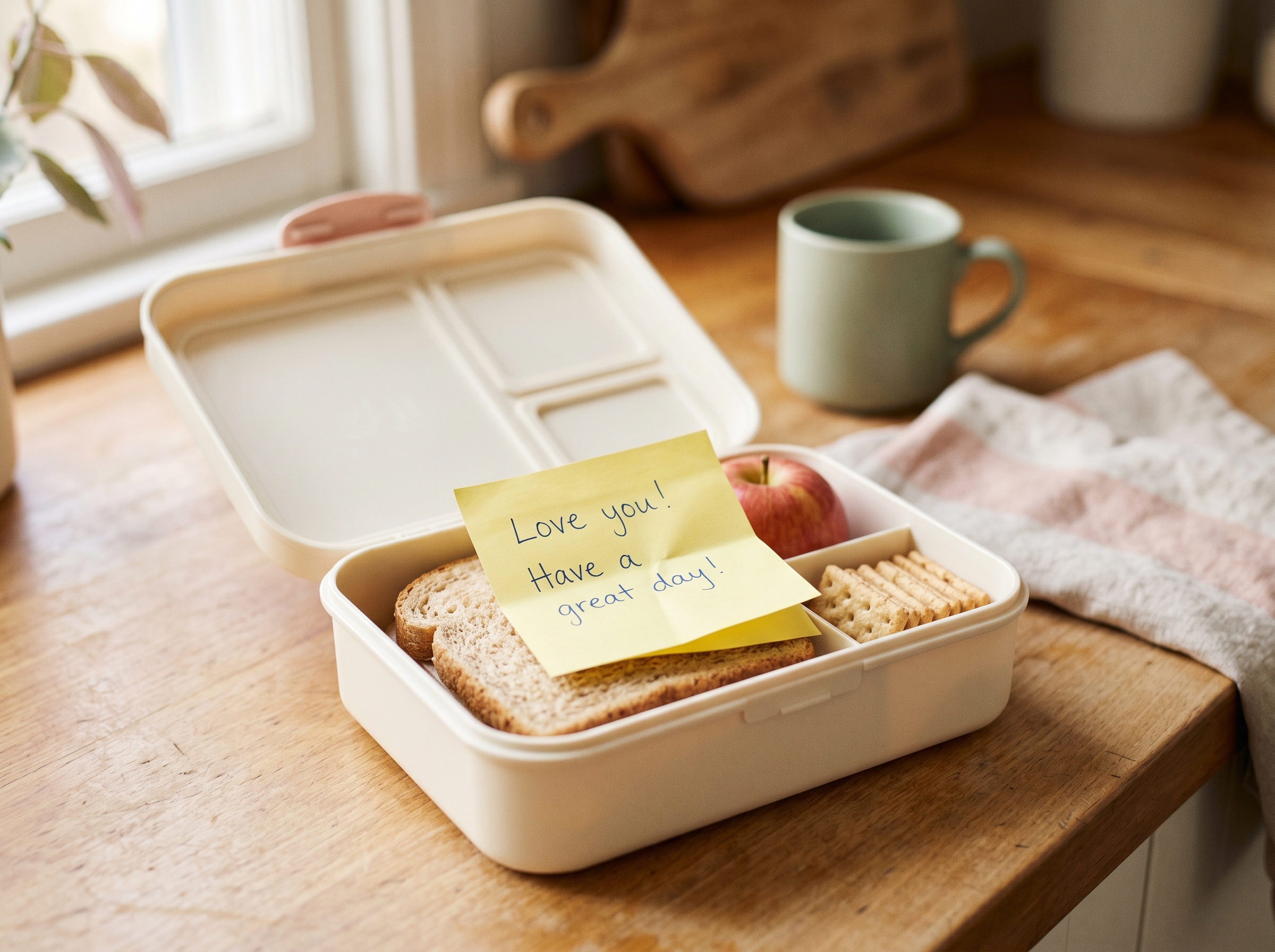
Lunchbox Notes They’ll Actually Want to Read
A note folded into a lunchbox takes 30 seconds and lasts all day. Here’s what to write based on where your kid actually is developmentally, because “I love you to the moon and back” hits differently for a five-year-old than it does for a sixth-grader. Lunchbox notes really hit their stride at the start of a new school year, so they slot naturally into the rest of your back-to-school routine.
Ages 3–5 (Pre-K and Kindergarten)
At this age, a teacher may read the note aloud, so keep it short and warm. A heart doodle alongside it is never a bad idea.
- “I love you so, so much!”
- “You make me smile every day.”
- “I can’t wait to hug you later.”
- “You are my favorite kid.”
- “Sending you a big squeeze. (Draw a heart here.)”
Ages 6–9 (Early Elementary)
This is the sweet spot for notes for kids lunchbox moments. They can read independently, they still think it’s cool, and you can get a little specific without it feeling weird. Mention something real when you can.
- “I loved watching you help your brother this morning.”
- “You worked so hard this week. I noticed.”
- “Being your mom is the best thing that ever happened to me.”
- “I’m thinking about you right now, and smiling.”
- “You are my favorite human and also you left your socks on the floor again. Still love you. (Heart.)”
That last one? Kids this age love it. It shows you see them fully and love them anyway.
Ages 10–12 (Tweens Who Would Rather Not Be Embarrassed)
Low-key is the vibe. No glitter, no “baby talk,” and definitely fold it so it’s private. As Parent.com notes, knowing your kid’s social context matters, especially for older kids who eat lunch with friends.
- “I see you. I’m proud of you.”
- “Today is going to be fine. You’ve got it.”
- “Can’t wait to hear how it goes.”
- “I like who you’re becoming.”
- “Love you. Text me if you need anything.”
And if the lunchbox note era is over at your house? Switch to a text. The medium doesn’t matter. The message does.

Short Love Messages for Kids to Say Out Loud Right Now
Not everything has to be written down. Some of the most powerful love messages for kids are said in passing, in the car, at the door, tucked into a quick goodnight. Here are 15 you can use today.
Warmth and connection:
- “You are my favorite part of today.”
- “Being with you is my favorite thing.”
- “I missed you when you were at school.”
- “I love spending time in your world.”
- “You make our family better just by being in it.”
Identity and strength:
- “I love who you’re becoming.”
- “You are so much braver than you know.”
- “The way you handled that made me proud.”
- “I see how hard you try. It shows.”
- “There is no one else like you, and that’s a good thing.”
Unconditional reassurance:
- “Nothing you do could ever change how much I love you.”
- “You don’t have to be perfect. I love you as you are.”
- “Even on hard days, my love for you doesn’t change.”
- “You are always, always safe with me.”
- “I will always be on your side.”
These sweet messages for kids work because they cover the emotional range. Some days your child needs warmth. Some days they need to feel capable. Some days they just need to know the ground beneath them is solid.
Affirmations That Double as Love Messages
Some kids, especially kids who carry anxiety, self-doubt, or big feelings, respond better to identity-based messages than repeated “I love you” phrases. That’s where affirmations for kids come in.
Child development experts note that children who receive identity-affirming statements alongside love messages tend to build stronger internal self-worth over time. The goal is to help them believe good things about themselves, not just feel loved by you. Here are 10 messages that do both:
- “You are exactly who you’re supposed to be.”
- “Being your mom is the best thing that ever happened to me.”
- “The world is better because you’re in it.”
- “You are kind, and kindness matters.”
- “You are brave, even when it doesn’t feel like it.”
- “You belong, everywhere you go.”
- “Your feelings make sense, and I’m here for all of them.”
- “You don’t have to earn love. You already have mine.”
- “There is so much good inside of you.”
- “I am so lucky you chose me to be your parent.”
Pro tip: write one or two of these on a card and tape it to their bathroom mirror. They’ll see it every morning without any awkwardness, and over time, they’ll start to believe it.
Deep Love Messages for the Big Moments
Sometimes a sticky note isn’t enough. Sometimes you want to say it in a way they might fold up and keep. These longer messages work for birthday cards, memory books, a letter tucked in a backpack on the first day of school, or a text to an older child who needs to hear it.
- “From the moment you arrived, you changed everything. I didn’t know what love like this felt like until I knew you. Whatever this year holds, I’m in your corner for every bit of it.”
- (From Mom) “I watch you grow and I feel so proud I can barely breathe. You came from me, but you’re entirely your own person, and that person is extraordinary.”
- “Today might feel hard. But I want you to know that you have never once been alone in anything, and you won’t be now. I’m here. I love you. That doesn’t change.”
- “I don’t need you to be the best at anything. I need you to know you’re my favorite person on any given day, at any given moment.”
- (From Mom) “You have made me a better human being. I hope someday you know how much light you’ve brought into this family, just by being exactly who you are.”
- “I’ve watched you face things this year that weren’t easy, and every single time, I’ve been so proud of how you showed up. I see you. I love you. Keep going.”
- “Happy birthday, kid. Another year of watching you become more yourself. I wouldn’t trade a single moment of it.”
- “You are loved not because of what you do or how you perform, but because you exist. That’s it. That’s the whole reason.”
A Few Ways to Make Any Message Feel Special
Plenty of lists give you the words. Here’s the part most skip: how to deliver them in a way that actually reaches your kid, without adding an hour to your morning routine.
- The mirror message: A dry-erase marker on the bathroom mirror takes ten seconds. They see it every morning before you’ve even had coffee.
- The pocket note: Fold a sticky note and tuck it into a coat pocket or a shoe. Finding it later in the day feels like a little surprise from you.
- The text chain: For kids with phones, start a dedicated thread. Just love notes, nothing else. It becomes something they look back at.
- The voice memo: Record yourself saying it and send it as a voice note. Hearing your actual voice saying “I love you” is different from reading it. Let them replay it.
- The repeat ritual: Same phrase, every single night, at the door or at bedtime. It might feel repetitive to you, but that’s the point. The “boring” love is the love that builds security. Consistent bedtime rituals that include verbal affirmation help children feel settled and safe, not just at night but throughout the following day as well.
Looking for more like this? Browse all our mom life stories.
FAQ: Love Messages for Kids
What are some cute love messages for kids?
Cute love messages for kids are usually short and specific. Try: “You are my favorite part of every day,” “I love you from your toes to your nose,” “Being your mom is my best job,” or “Nothing could ever make me love you less.” The most effective ones feel personal, not generic, so swap in a detail about your child when you can.
How often should I tell my child I love them?
Daily, without hesitation. Child development professionals and the American Academy of Pediatrics consistently recommend verbal affirmation as part of building secure attachment. There is no “too much” when it comes to a child knowing they are loved. The repetition is the point.
What should I write in a lunchbox note for my kid?
Keep it short, age-appropriate, and specific to them when possible. For little ones, three to five words with a doodle is plenty. For school-age kids, mention something real you noticed about them recently. For tweens, keep it brief and fold it for privacy. The specificity is what makes it feel like it’s for them, not just a generic message.
Are love messages different from affirmations for kids?
They overlap, but they’re not the same thing. Love messages express your feelings toward your child (“I love you, I’m proud of you”). Affirmations for kids build their internal beliefs about themselves (“You are brave, you are kind”). The best notes do both at once, which is why identity-based love messages tend to be so effective for kids who struggle with self-doubt.
What do you say to a child who doesn’t like being told “I love you”?
Some kids, especially older ones, feel awkward with direct verbal expressions of love, and that’s okay. Try written notes instead of spoken words, or lean into acts of service (making their favorite meal, showing up to their events). Physical touch like a quick shoulder squeeze can carry the same message. The concept of love languages, explored by family counselors and parenting resources, is worth looking into if words feel like a barrier with your kid. The message matters more than the method.


