
Best Planners for Moms
A mom planner is a physical or digital planning tool designed to consolidate a family’s schedules, kids’ activities, household to-dos, and personal goals into one organized system, helping moms reduce mental load and stay on top of their day without relying on memory alone.
Last updated: July 2026
Quick Answer: Best Planners for Moms
The best planners for moms go beyond a basic weekly grid. They account for multiple kids’ schedules, household management, and the mental load that comes with running a family. Whether you’re a stay-at-home mom, a working mom, or a homeschool mom, there’s a planner format built for the way you actually live. The key is matching the layout to your real life, not forcing yourself into a system designed for someone else.
You know that feeling when you’re mentally juggling soccer pickup, a prescription callback, what to make for dinner, and a permission slip that was due yesterday? That’s not disorganization. That’s just mom life with no external storage system. Your brain was never meant to be a filing cabinet for four people’s logistics, and no amount of willpower changes that.
The good news: the right planner can offload a surprising amount of that mental traffic. But “right” looks different depending on your situation. A stay-at-home mom managing a household full-time has different needs than a working mom splitting her week between an office and school pickups, and a homeschool mom needs things neither of them do. This article covers all of them.
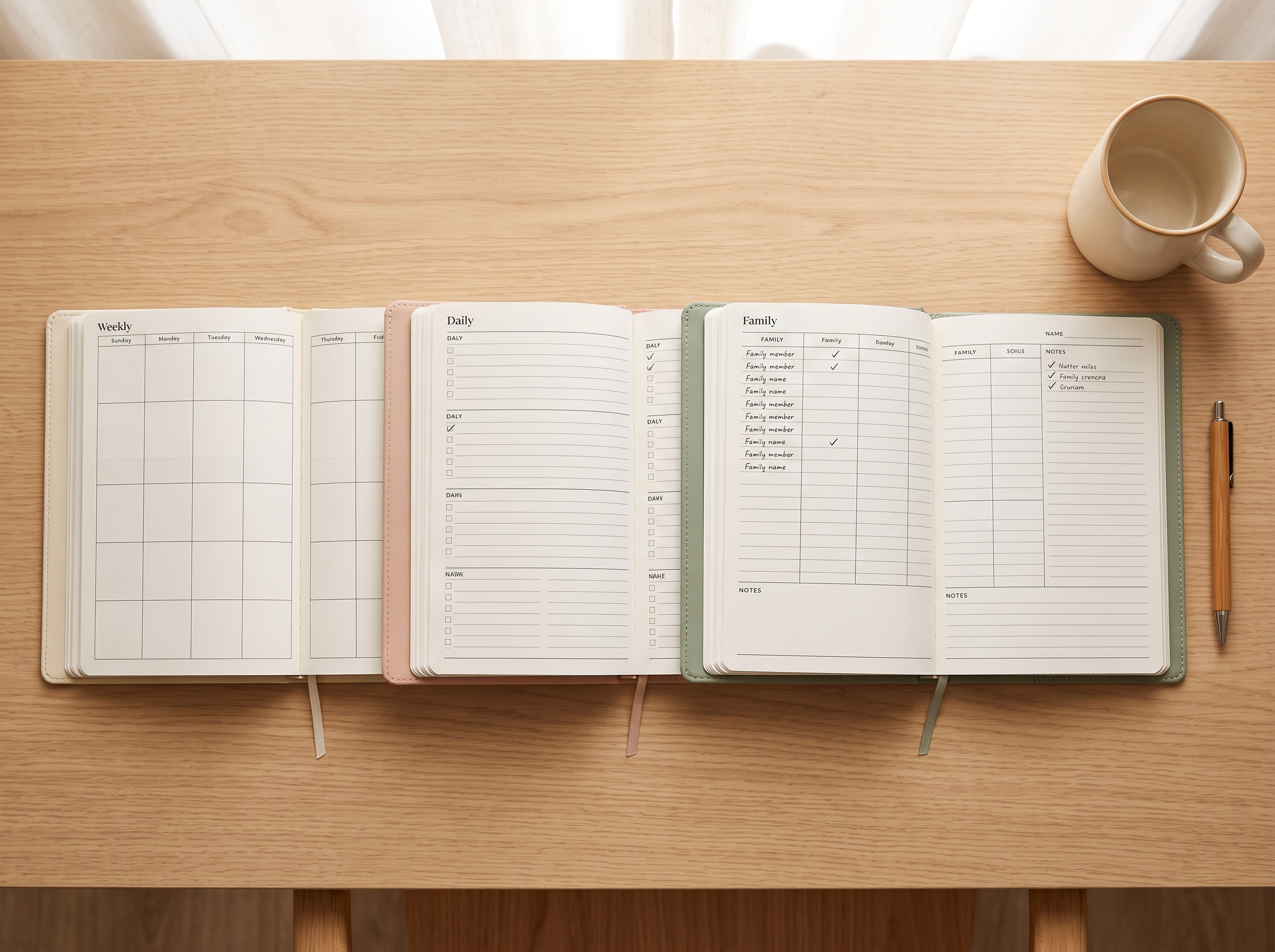
What Actually Makes a Planner Work for Moms (vs. Everyone Else)
Most planner guides skip straight to the product roundup without explaining why mom planning is a different problem. A standard productivity planner is built for one person managing their own tasks. A mom planner has to manage multiple people’s lives, often with zero control over how those lives change on any given day.
That distinction matters when you’re choosing a format. A rigid hourly time-block system works fine for a solo professional. It falls apart the second a kid wakes up sick, school ends two hours early, or nap time evaporates. Mom life is non-linear, and the best mom planners are designed around that reality.
Here’s what to look for when you’re evaluating any planner:
- Paper weight: 80 gsm minimum to prevent marker and pen bleed-through. If your kids ever touch your planner (they will), this matters.
- Binding: Lay-flat coil or disc binding so it stays open hands-free. Sewn-spine planners look clean but close themselves the moment you set them down.
- Family columns or kids’ rows: Look for at least 2–3 dedicated child rows or a separate family column per day view. A planner that only has space for your own to-dos will feel cramped within a week.
- Planning horizon: Weekly view works well for big-picture thinkers who need to see the whole week at once. Daily view suits moms managing hour-by-hour schedules with less flexibility.
The deeper goal is reducing decisions, not multiplying them. If your planner requires setup, maintenance, and interpretation every morning, it won’t stick. The best systems are the ones you open and immediately know what to do.
If you’re also thinking about broader home organization beyond just the planner itself, pairing it with small, consistent habits for staying organized at home makes the whole system easier to maintain.
The Best Mom Planners, Broken Down by Your Real Life
Instead of a generic top-ten list, here’s what I’d actually recommend based on the type of mom you are. Because a planner that’s perfect for one situation can be completely wrong for another.
For the Busy Mom Who Needs Everything in One Place
The Erin Condren LifePlanner is one of the most flexible options out there for a busy mom planner. It comes in weekly vertical, horizontal, hourly, and compact vertical layouts, printed on 80 lb. thick paper, coil-bound so it lays flat. Pricing runs roughly $55–$65 for a 12-month or 18-month option.
What makes it work for busy moms specifically is the column structure. You can dedicate one column to kids’ activities, one to work or personal appointments, and one to household tasks, all in a single weekly spread without needing a separate notebook for each. It also includes built-in habit trackers and goal pages, which matter more than they sound. Having your priorities on the same page as your schedule means you’re less likely to spend the whole week in reactive mode and never touch the things that actually matter to you.
If you’re managing work and family life simultaneously, the Erin Condren is worth a close look. It’s one of the few planners that scales with a packed schedule.
For the Stay-at-Home Mom Who Runs the House Like a CEO
The stay-at-home mom planner that stands out is The Dailee Mom Planner. The 2026–2027 edition runs August 2026 through July 2027 and is spiral-bound with premium covers, thick paper, and a layout that was designed specifically around motherhood rhythms rather than repurposed from a generic productivity format. It includes dedicated sections for family schedules, meal planning, kids’ info pages, and chore charts. Pricing starts at $49 for the weekly version and $55 for the full daily option.
For SAHMs who want a digital option, The Dailee also offers a GoodNotes-compatible digital planner at $18 and a Notion-based version at $28. And their Family Fridge Calendar ($34) pairs well with the planner if you want a visual command center in the kitchen alongside your personal planning pages.
The thing I appreciate about The Dailee is that it treats household management as a legitimate full-time operation, because it is.
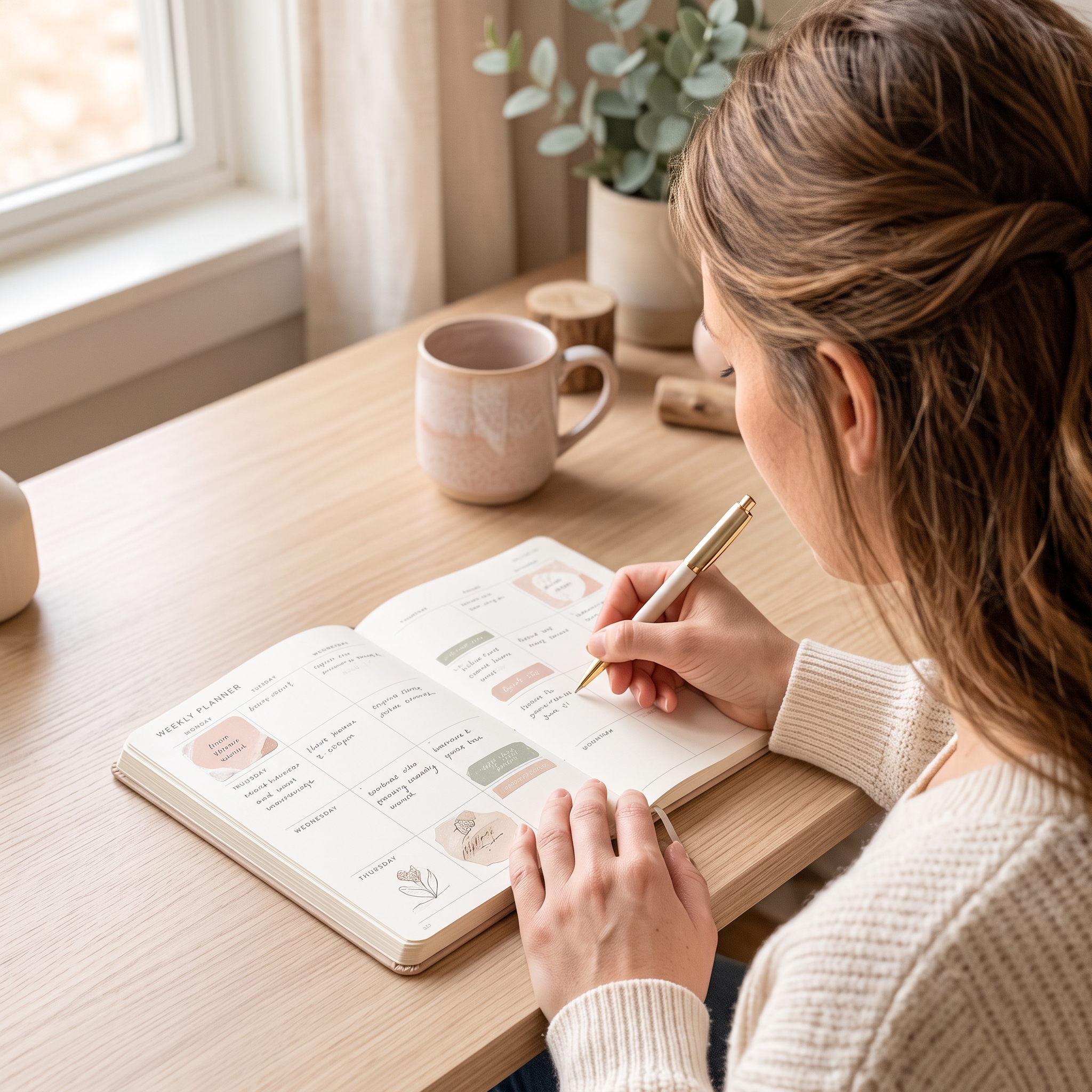
For the Homeschool Mom Who Needs Two Systems in One
Homeschool moms are underserved by almost every standard planner roundup, and that’s a problem worth fixing. A homeschool mom planner needs features that don’t show up in regular mom planners at all:
- Subject/lesson tracking columns: At least 4–6 subject rows per day, depending on how many kids you’re teaching
- Attendance log pages: Required in many states for homeschool record-keeping
- Academic year view: August through July, not January through December
- Per-child progress tracking: Space to note where each child is independently, not just what was taught that day
If you want a dedicated digital option, Homeschool Panda is an online lesson-planning tool worth a look for subject tracking and attendance logs. For a paper-based system, a disc-bound binder (Levenger or Staples Arc) lets you combine homeschool-specific inserts with your personal planning pages in one binder that actually grows with your family.
One practical tip: choose an undated planner if your school year runs off the standard calendar. Undated planners let you start whenever you need to without wasting pages, which saves money and avoids the guilt of a planner that looks half-empty by March.
For the Mom with ADHD Who’s Tried Every Planner and Quit by February
ADHD moms don’t fail at planning. They fail at systems that require too many steps, too much visual noise, or too much daily maintenance to stay current. If that sounds familiar, the fix isn’t more willpower. It’s a different kind of planner.
What to look for:
- One-page-per-day layouts: Not cluttered weekly spreads with twelve small labeled boxes
- Open white space: Pre-labeled boxes that feel constraining are a fast path to abandonment
- Immediate visibility: A planner that requires opening to a specific tab is a planner that won’t get opened at all
- Brain dump sections: A lined “parking lot” page for the thoughts that arrive at 11 p.m. is not optional
The Full Focus Planner (around $50) is structured around three Most Important Tasks per day, which keeps the daily page focused without feeling overwhelming. The Ink+Volt Goal Planner is worth considering for moms who need a sense of purpose alongside their task list.
A disc-bound system with a dashboard or “today” flag often works better than a fixed-date planner for ADHD moms. Missing a week doesn’t create a shame spiral when you can simply move your flag forward and keep going. The planner waits. It doesn’t judge.
For the Mom Who Wants to Try a Planner Without Committing $50
Before spending premium prices on a planner you’re not sure will work for you, start lower and test your preferences first. Here’s a quick price breakdown:
- Under $20: Bloom Daily Planners (monthly, undated; roughly $17–$20) are a simple, functional starting point with a clean layout and enough flexibility for most mom schedules
- $20–$40: Panda Planner Pro (around $32) adds mood tracking, gratitude prompts, and daily priority structure for moms who want a bit more scaffolding
- $40 and up: Erin Condren and The Dailee offer better paper quality, more thoughtful layouts, and features built around family life specifically
If you’re brand new to paper planning, try a free printable layout for two weeks before buying anything. It sounds like extra effort, but it’ll tell you whether you naturally reach for a daily or weekly view, which is the most important thing to know before you spend $55 on something you might hate.
Paper Planner or Digital: Here’s How to Actually Decide
The honest answer is: it depends on where you already live. If your whole life is already in your phone and you’re synced with your partner’s Google Calendar, a paper planner is unlikely to become a consistent habit. That’s not a character flaw. It’s just friction.
Paper planning tends to win when:
- You need the physical act of crossing something off to feel done
- You have multiple kids and want to see the whole week without unlocking a screen
- You want a tech-free ritual in the morning
- You find that writing by hand helps you actually remember what you’ve written
Digital planning tends to win when:
- You need reminders and alerts for appointments you’d otherwise forget
- You’re already syncing with a partner or co-parenting calendar
- You travel frequently and don’t want to carry a physical notebook
- Your kids’ schools communicate primarily through an app
The hybrid approach is what many organized moms actually land on: use a digital calendar (Google or Apple) for time-specific appointments that need alerts, and a paper planner for daily priorities, to-dos, and brain dumps. The two tools do different jobs and don’t compete with each other when you use them that way.
For iPad users who want the write-by-hand feel without the physical notebook, The Dailee’s digital planner ($18) is GoodNotes-compatible and brings the same mom-specific layouts into a fully digital format.
The One Habit That Makes Any Mom Planner Actually Work
No planner works on its own. Any planner you buy will sit unused within three weeks if there’s no consistent ritual attached to it. This is the part most planner guides skip entirely, because they’re in the business of selling planners, not coaching how to use them.
The system that works for most moms is a Sunday reset combined with a short daily check-in:
- Sunday (10 minutes): Fill in the week’s non-negotiables, including appointments, pickups, and deadlines. Identify one priority for each day, not five.
- Each morning (5 minutes): Open to today, write your three Most Important Tasks, and check whether anything shifted overnight.
- Each evening (2 minutes): Roll any uncompleted tasks to tomorrow, note one thing that went well.
That’s 17 minutes total on a full day. If you’re looking for more ways to reclaim small pockets of time in the rest of your day, these mom hacks that actually save time pair well with this system. Most moms find it’s easiest to protect the morning five minutes before anyone else wakes up, or right after the kids leave for school.
The single biggest predictor of whether a planner gets used? Whether it’s visible. A planner left open on the kitchen counter gets used. A planner in a bag does not. It sounds small, but leaving it out, open to the current week, removes the activation energy that stands between a chaotic day and an organized one.
And when you miss a few days (you will, we all do), the goal is to return without guilt. Flip to today, write your three tasks, and keep going. Working moms juggling career and family life especially benefit from this kind of low-pressure reentry, and if you’re curious about the broader picture of what working moms model for their kids, there’s good evidence the effort is worth it.
Frequently Asked Questions About Mom Planners
What is the best planner for a mom with multiple kids?
Look for a planner with a dedicated family column or at least three color-coded rows per day view, one per child plus one for yourself. The Mom Agenda and The Dailee Mom Planner are built specifically for multi-child households. A disc-bound system with expandable inserts also scales naturally as your family grows, since you can add pages without replacing the whole planner.
What’s the best planner for a stay-at-home mom?
A stay-at-home mom needs a planner that handles household management and personal goals, not just appointments. The Dailee Mom Planner and Erin Condren LifePlanner both offer dedicated home and personal sections. Pairing either one with a fridge family calendar gives you a command-center effect: the personal planner for your own priorities, the wall calendar for the family’s shared schedule.
Are there good planners for moms with ADHD?
Yes, but the key is simplicity over features. Look for one-page-per-day layouts, open white space, and a built-in brain dump section. The Full Focus Planner and Ink+Volt Goal Planner are strong choices. Avoid heavily pre-structured weekly spreads with many small labeled boxes, they create visual overwhelm and tend to stall the planning habit before it gets started. A disc-bound system with a dashboard flag is also worth considering for days when you fall behind.
What’s the difference between a 12-month and an 18-month mom planner?
A 12-month planner runs January through December (or a defined academic year). An 18-month planner typically starts mid-year, often July, and runs through the following December. The 18-month option is useful if you want to start fresh now rather than waiting for January. Both cover the same planning features; the longer format just gives you more runway and slightly better per-month value if you stick with it.
How much should I spend on a mom planner?
Budget planners like Bloom Daily run $17–$20 and are a good fit for first-time users testing different layouts. Mid-range options like the Panda Planner Pro ($25–$40) add structured goal-tracking and mood sections. Premium planners ($45–$65), including Erin Condren and The Dailee, offer better paper quality, more customization, and layouts designed specifically around family life. At $55 for a 12-month planner, you’re spending about 15 cents a day. The investment makes sense if you’ll actually open it.


