
Montessori Potty Training: How It Works
Montessori potty training is a child-led approach starting around 12 months, using environmental preparation and readiness cues instead of pressure or rewards.
Last updated: July 2026
Quick Answer: Montessori Potty Training Explained
Montessori potty training, more accurately called Montessori toilet learning, is a gradual, child-led process that treats using the toilet the same way a child learns to walk or talk: as a developmental milestone, not a skill adults drill into them. Instead of an intensive weekend push, it relies on a prepared bathroom environment, consistent low-pressure opportunities, and natural body awareness. Most families begin introductions around 12 months and reach full daytime independence somewhere between 18 and 36 months.
Everyone assumes potty training has to be a big event. A long weekend, a stack of M&Ms, a sticker chart taped to the wall. If that mental image is already stressing you out, the Montessori approach is going to feel like a relief.

Montessori Toilet Learning Is Not a 3-Day Boot Camp
Popular intensive methods, including the widely read “Oh Crap” book, are sometimes called Montessori-adjacent because they drop rewards and punishments. That’s where the similarity ends. The Montessori method doesn’t ask parents to pick a Saturday and hustle their toddler through a crash course. It asks parents to step back.
In The Secret of Childhood, Maria Montessori described what researchers now call “muscular memory,” the child’s developing internal sense of their own body and its movements. Toileting, in the Montessori view, is part of that self-construction process. The child is wired to figure it out. The adult’s job is to prepare the environment and get out of the way.
| Approach | Who Leads | Timeline | Rewards Used? |
|---|---|---|---|
| Traditional / 3-Day | Parent | 1–3 days intensive | Often yes |
| Montessori | Child | Months, gradually | Never |
According to Nicole Kavanaugh, Montessori parenting expert and writer behind The Kavanaugh Report, the only role of the adult is to prepare the environment for toileting and give children opportunities to go. That’s it. No performance required from anyone.
The Best Age to Start Montessori Potty Training
Here’s the part that surprises most parents: Montessori toilet learning doesn’t start at age two or three. It starts much earlier than most American families expect, and that early start is exactly what makes the eventual transition smoother.
Phase 1: Toilet Awareness (6–12 Months)
Some Montessori experts recommend simply offering potty sits after waking, after meals, and at diaper changes, not to train, but to build body awareness. This overlaps with elimination communication principles and is entirely optional. The goal at this stage isn’t success. It’s familiarity.
By around 9–12 months, most babies can sit independently and show some awareness that elimination is happening. Noticing that is enough.
Phase 2: The Readiness Window (12–18 Months)
This is the window the Montessori approach considers optimal for active introduction. Signs to watch for include staying dry for stretches of an hour and a half or more, showing curiosity about the bathroom, pulling at a wet diaper, or communicating (in any way) before or after eliminating.
Worth knowing: according to the American Academy of Pediatrics, full sphincter control typically matures between 18 and 24 months for most children. Starting Montessori awareness at 12 months is preparation, not pressure. You’re building the groundwork before the hardware is fully online.
Phase 3: Full Daytime Transition (18–36 Months)
This is when most children in a Montessori approach move out of diapers during waking hours. The runway is longer than a 3-day method, often six to twelve months from active introduction to consistent dryness, but families who go this route typically report fewer regressions and less conflict overall.
One thing to separate out early: nighttime dryness is a completely different developmental process, often not fully in place until age three to five. If you’re in the thick of that stage on its own, our night-time potty training guide walks through it. Don’t conflate daytime success with nighttime readiness. They’re on different timelines and that’s completely normal.
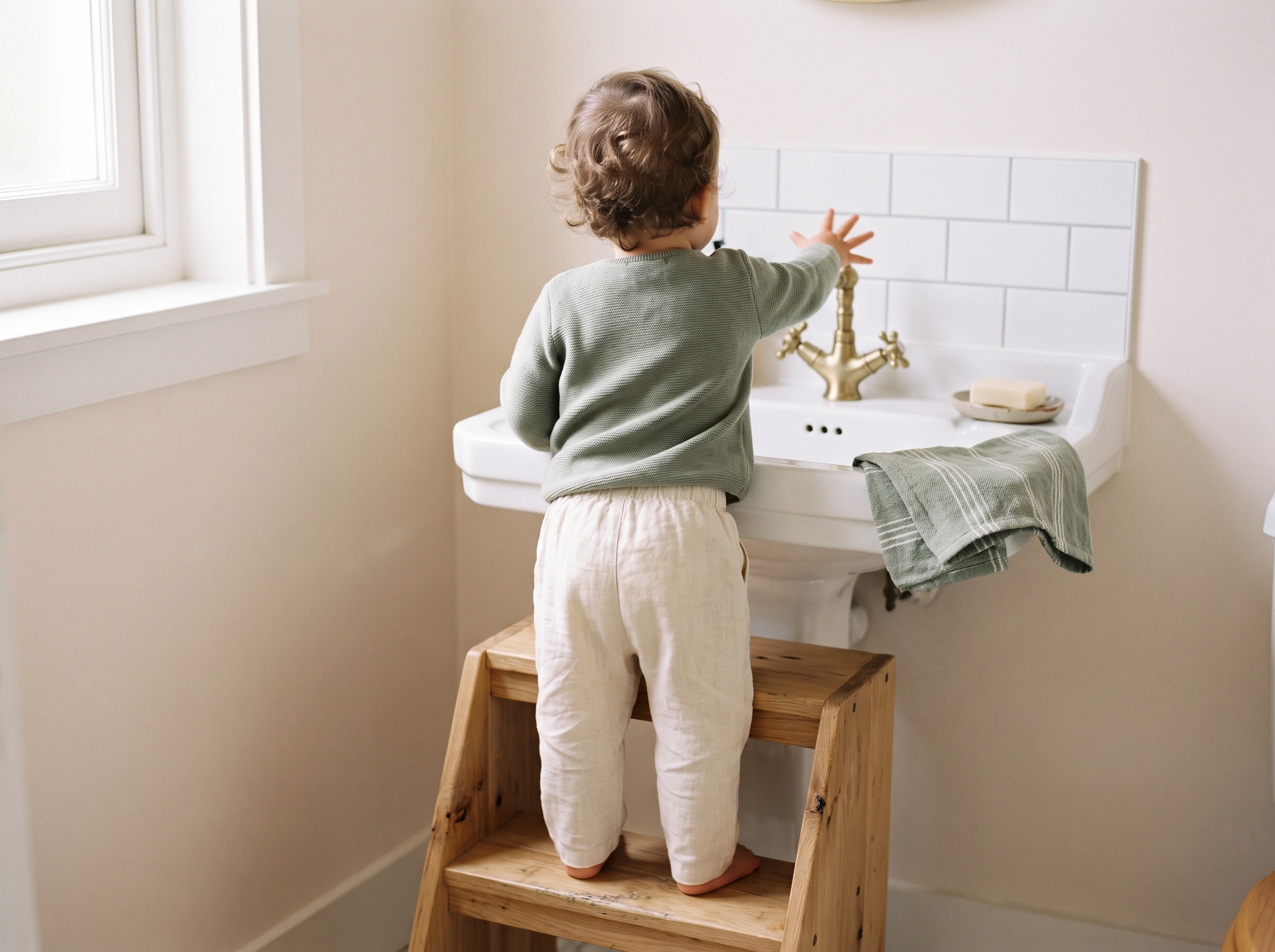
Set Up the Environment Before Your Child Shows Any Interest
This is core Montessori thinking: prepare the environment first. Don’t wait until your child is already “showing signs.” Have everything in place before that window opens, so when the interest arrives, there’s no scramble.
Choosing the Right Montessori Potty
A floor-level standalone potty is the Montessori standard, not a reducer seat on the full toilet. The reason is practical: when a child’s feet rest flat on the floor, they have postural control and feel physically secure. That reduces anxiety and gives them a real sense of confidence.
What to look for in a Montessori potty: seat height roughly 5–7 inches off the ground, a stable non-tipping base, and a simple design with no musical buttons or cartoon characters. The entertainment features on some toddler potties actually work against you here by making the potty feel like a toy rather than a functional tool.
A basic Montessori toilet learning kit doesn’t need to be elaborate. A floor potty, a basket of training pants, a small accessible wipes holder, and a low hook for a hand towel covers everything. A step stool and toilet insert is a reasonable alternative once a child is closer to two and a half, but for younger toddlers the floor potty wins every time. If you’re already setting up other toddler learning activities with accessible, child-height materials, this same logic applies directly to the bathroom corner.
Training Pants Over Pull-Ups
Cloth or cotton training pants let children feel wetness immediately. That sensory feedback is central to building body awareness in the Montessori approach. Pull-ups are designed to keep skin feeling dry, which is great for nighttime but actively disrupts the feedback loop during daytime learning.
Stock at least 10–12 pairs during the active learning phase. It sounds like a lot, but it significantly cuts down on laundry stress when accidents (and there will be accidents) are happening regularly. The tactile information from wet training pants is also part of why toddler sensory activities that build body awareness pair so naturally with this process.
What You Actually Do on a Normal Day
Philosophy is great, but most parents want to know: what does Tuesday look like? Here’s how this plays out in real life.
Offering Opportunities Without Making It a Big Deal
“Offer, don’t insist” is the core Montessori rule for toilet time. Natural offer points include after waking from a nap, before leaving the house, and after meals. That last one is because the gastrocolic reflex often triggers a bowel movement 20–30 minutes after eating, making post-meal potty offers especially productive.
Sit with your child, stay calm, and give it two or three minutes. No hovering, no narrating, no “try harder.” If nothing happens, move on without commentary.
The Language That Actually Helps
Specific phrases matter more than most potty training guides acknowledge. One swap that makes a real difference: stop asking “Do you need to go potty?” Toddlers will almost always say no, even when they obviously need to go. Instead, try a calm statement: “Your body might be telling you it needs to go. Let’s walk to the potty.” You’re narrating body cues, not requesting a performance.
During accidents, keep the language factual and free of disappointment: “Your pee came out. That happens. Let’s get dry clothes and try again next time.” That’s it. No sigh, no “we just went,” no “you were so close.” Neutral tone is the whole game.
Handling Accidents Without Derailing the Process
Accidents aren’t failures. In the Montessori framework, they’re expected information. Most children will have frequent accidents for weeks to months before consistent dryness, and normalizing that timeline upfront is one of the most useful things a parent can do for their own stress levels.
Involve your child in age-appropriate cleanup: hand them a towel, let them carry training pants to the laundry basket. This builds responsibility and agency without any shame attached to the accident itself.

Why Montessori Skips the Sticker Chart
The Montessori method doesn’t skip rewards just because they feel punitive. It skips them because they actually backfire developmentally. External rewards (stickers, candy, big praise like “I’m so proud of you!”) shift a child’s motivation from their own internal body awareness to adult approval. That’s a problem, because adult approval isn’t always available, and children who are reward-dependent often stall or regress when the incentive disappears.
Safety note: If you’ve used or are considering candy rewards such as small chocolates or hard candies with toddlers under 3, be aware that these are choking hazards. Always supervise young children closely around any small food items, and check with your pediatrician about age-appropriate treat sizes before using food as a training reward.
Replace the chart with calm, body-focused acknowledgment: “You listened to your body. That’s what the potty is for.” Mastery itself is the reward. That internal satisfaction is exactly what the Montessori approach is designed to build, and it sticks far longer than a sticker ever does.
What Happens When Your Child Goes to a Non-Montessori Daycare
This is a real pain point that doesn’t get nearly enough attention. You’re following a gradual, child-led approach at home, and then daycare sends home a note that says children must be fully potty trained by age three. Now what?
First, the clarification: authentic AMI and AMS Montessori primary (3–6) classrooms do generally expect a child to be toilet independent by the time they transition in, but in practice that’s usually already in place, since toilet learning happens earlier, during the toddler program. Toileting is considered part of practical life learning, and a directress can often work with a family whose child is close but not quite there yet. You can verify this with your specific school by asking directly about their toilet learning policy.
Non-Montessori daycares are a different story, and if that’s your situation, here’s what actually helps. Talk to caregivers about the “offer, don’t insist” approach so they understand your method. Send a clearly labeled bag with plenty of training pants. Ask about their accident policy before an accident happens, so nobody’s caught off guard. Consistency across home and care settings speeds up the process, so even a partial alignment from caregivers makes a meaningful difference.
When Your Potty-Trained Toddler Suddenly Regresses
Regression is one of the most common potty-related searches parents make, and it’s almost never addressed in Montessori toilet learning content. So let’s talk about it plainly: it happens, it’s normal, and it doesn’t mean the method failed.
Common triggers include a new sibling, a move, starting preschool, an illness, or any significant routine disruption. The Montessori response is to go back to basics without drama. Quietly return to offering opportunities. Swap back to training pants if needed. Keep language completely neutral.
A useful script for regression moments: “Your body is still learning. It’s okay. We’ll keep practicing.” That’s all that’s needed. Most regressions resolve within a few weeks when handled calmly and without any reintroduction of rewards or expressions of disappointment. What doesn’t help: framing it as “going backwards,” bringing back the sticker chart as a fix, or letting your frustration show. The calmer the adult, the faster the bounce-back.
FAQ: Montessori Potty Training Questions Answered
What is the best age to start Montessori potty training?
Start setting up the environment and offering casual potty sits around 12 months. The full daytime transition typically happens somewhere between 18 and 36 months, depending on the child. There’s no single “right” age, the range is wide and individual.
Do Montessori schools require potty training before enrollment?
Authentic AMI and AMS Montessori primary (3–6) classrooms generally do expect toilet independence by the time a child transitions in, though this is usually already in place since toilet learning happens earlier, during the toddler program. Toilet learning is treated as part of practical life in the classroom, and trained teachers can work with a family whose child is close but not quite there. That said, policies vary by school, so always confirm directly with yours before enrollment.
What’s the difference between Montessori potty training and the “Oh Crap” method?
Both approaches skip rewards and punishments, which is why people sometimes lump them together. But Oh Crap is adult-directed and compressed, typically unfolding over one to two weeks with a fairly structured sequence. Montessori is child-led and plays out over months. The pace and the decision-maker are fundamentally different.
Is there a Montessori potty training book worth reading?
The Montessori Toddler by Simone Davies is a broad resource with solid toilet learning sections and is written in accessible, parent-friendly language. Diaper Free Before 3 by Jill Lekovic, MD, aligns closely with the Montessori philosophy on early introduction. For read-alouds with your toddler, Everyone Poops by Taro Gomi is widely recommended in Montessori circles as a low-key, body-positive intro to the concept.
What if my child shows zero interest at 18 months, should I push it?
No. Keep the environment prepared, keep offering calmly, and keep the tone completely neutral. Interest can emerge anywhere from 12 to 24-plus months, and the range is normal. Following the child’s pace isn’t a workaround in the Montessori approach, it’s the method. Your job is consistent, low-pressure exposure. That’s enough.


