
Work From Home Mom Tips (Schedules That Work)
Work from home mom tips are scheduling and boundary strategies that help mothers balance professional responsibilities and childcare in the same physical space, using protected time blocks built around children’s natural rhythms rather than a traditional 9-to-5 structure.
Last updated: July 2026
Quick Answer: Work From Home Mom Tips That Actually Hold Up
The most effective work from home mom tips all share one thing in common: they stop trying to replicate an office schedule and start working with your kids’ rhythms instead. That means identifying your child’s most predictable windows (nap time, school hours, quiet play) and guarding those blocks like they’re client meetings. Everything else gets batched, delegated, or dropped.
The kitchen smells like yesterday’s coffee you never finished, your laptop is open, your to-do list is staring at you, and someone just appeared at your elbow asking for a snack they could absolutely reach themselves. Sound familiar? If you’re a work from home mom, that scene isn’t a character flaw. It’s Tuesday.
Working from home with kids in the house is one of the harder juggling acts in modern family life. The tips below aren’t about hustle or perfect morning routines. They’re about building a structure that actually holds, even when your toddler decides nap time is optional and your inbox disagrees.

The Real Reason Your WFH Schedule Keeps Falling Apart
Most WFH advice was built for someone with a dedicated home office, reliable childcare, and no one asking them where the goldfish crackers are. That’s not most of us.
The deeper problem is that the traditional 9-to-5 structure was never designed with primary caregivers in mind. According to Pew Research’s 2023 data, roughly 35% of workers with jobs that can be done remotely work from home all the time, and another 41% work a hybrid schedule. But remote work policies were built around the assumption that you’d simply be at home instead of the office, not at home managing children and a job simultaneously.
Trying to mirror an office schedule from your kitchen table is the wrong framework entirely. Being productive as a work-from-home mom requires a different system. One that’s flexible enough to absorb the chaos of family life but structured enough that you actually get things done.
The fix isn’t more discipline. It’s a better model.
Build Your Work Blocks Around Your Kids, Not the Other Way Around
Instead of fighting your kids’ schedule, start by mapping it. Identify three or four predictable windows in your day when your children are occupied, sleeping, or at school. Those windows become your work blocks.
Research on focus and cognitive performance suggests most people sustain deep concentration in roughly 90-minute cycles. That’s your benchmark for a single work block. Three solid 90-minute blocks in a day can match the output of an eight-hour office day when you strip out commuting, unnecessary meetings, and hallway interruptions.
Here are three named methods depending on your situation:
The Nap-Stack Method (Best for: Work From Home Mom With Toddler)
If your child is under three and still napping once or twice a day, this is your most protected time. Stack your highest-priority, deepest-focus task into the first nap window, typically somewhere around 12 to 2 pm. Use a second nap, if you still have one, for email and lighter admin.
Toddler naps commonly run about 1 to 2 hours for kids between ages one and three, though every child is different. Plan your actual work window at about 45 minutes to account for settle-down time on both ends. One practical move: set up your workspace and close any browser tabs you don’t need before nap starts. You’ll lose ten minutes of that precious window if you spend it getting situated.
The Early-Window Method (Best for: Morning People or Anyone Who Can Shift Their Alarm)
Wake up 60 to 90 minutes before your kids and use that window for focused work, writing, or calls that need silence. It’s the tip you’ll see repeated everywhere in WFH advice, and it works when you can pull it off.
The honest caveat: it only works if you’re sleeping enough to sustain it. The CDC recommends adults get at least 7 hours of sleep for healthy cognitive function. A 5 am alarm after a 1 am night doesn’t produce productivity; it produces mistakes and a shorter fuse by 3 pm. This is one option, not a requirement.
The Split-Shift Method (Best for: School-Age Kids or Part-Time Childcare)
Work block one runs from school drop-off to noon. That’s your deep work and client call window. Then you fully stop for pickup and the afternoon transition. Work block two, if needed, happens after kids’ bedtime for lighter tasks like email, planning, and scheduling.
This method pairs well with batching, which means grouping similar tasks (all calls together, all writing together, all email together) into the same block so you’re not context-switching every 20 minutes. Context-switching is where most WFH hours quietly disappear.
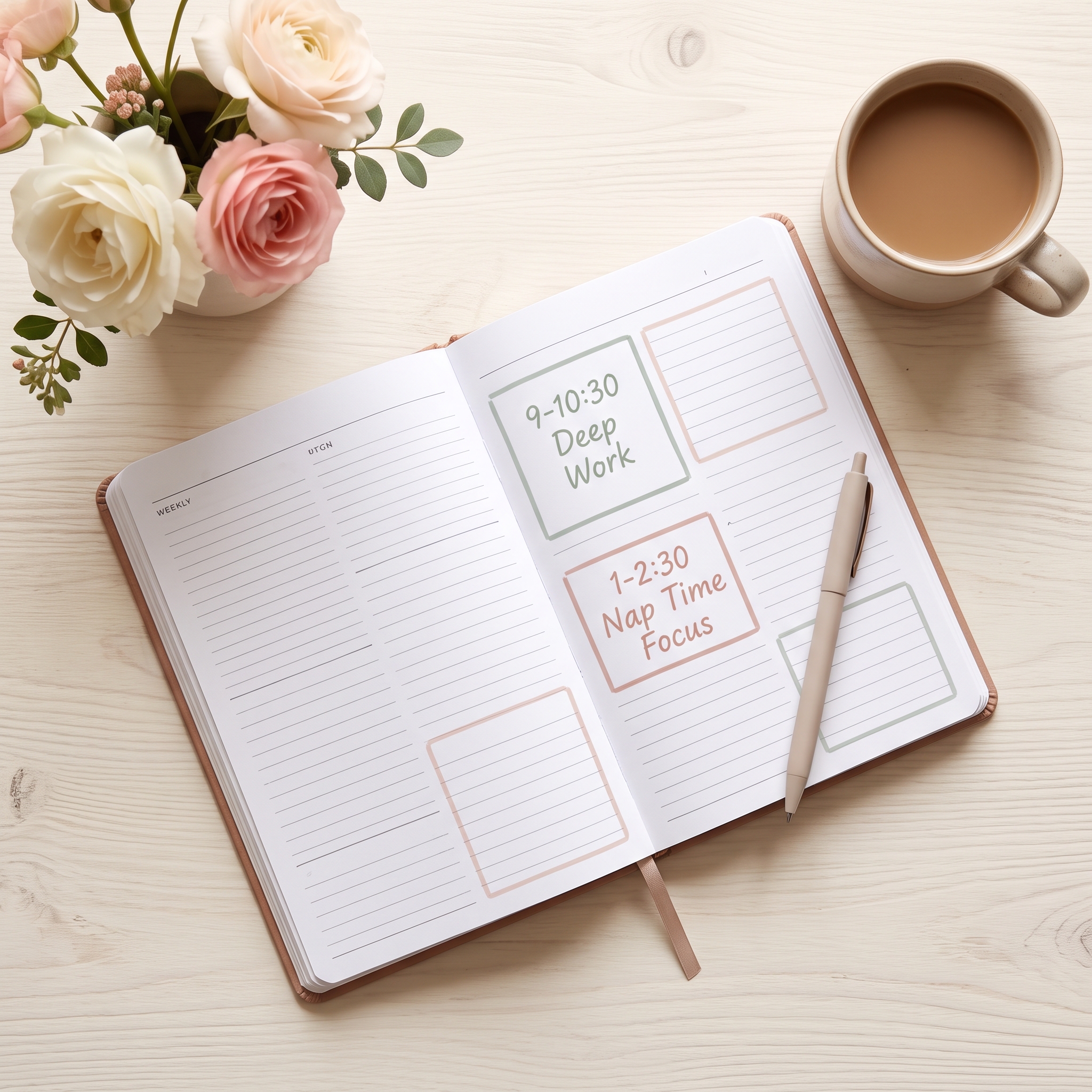
What a Realistic WFH Mom Day Actually Looks Like
Here’s a sample schedule for a mom with a 2.5-year-old and a seven-year-old, working a part-time remote job. It’s not perfect. Some days it falls apart completely. But it gives you something to return to.
| Time | What’s Happening |
|---|---|
| 6:00–7:00 am | Early window: check email, write out top three priorities for the day |
| 7:00–8:30 am | School-age kid morning routine and drop-off |
| 8:30 am–12:00 pm | Deep work block (toddler in childcare or rotating independent play) |
| 12:00–1:00 pm | Lunch and toddler nap transition |
| 1:00–2:30 pm | Nap-stack block: focused work or calls |
| 2:30–3:00 pm | Email and admin buffer before toddler wakes up |
| 3:00–6:00 pm | Family time, school pickup, dinner, protected, not optional |
| 8:30–9:30 pm | Optional: light admin, write tomorrow’s plan |
The schedule exists to return to, not to execute flawlessly. Days will derail. A sick kid, a missed nap, a deadline that moved. That’s not failure; that’s Tuesday with children in the house.
The protected 3 to 6 pm block is non-negotiable in this setup. If you want low-effort, fast dinners that fit that protected window, a sheet-pan teriyaki chicken and vegetable dinner comes together in about 30 minutes with minimal thinking required after a long workday.
When Your Toddler Won’t Give You 20 Minutes of Peace
Here’s the developmental truth: toddlers aren’t ignoring your work schedule because they’re being difficult. They’re developmentally incapable of understanding that “Mommy is working” means anything other than “Mommy is here.” This isn’t a discipline problem. It’s just how young children are wired.
That said, there are practical strategies that stretch independent play time without screens:
- Activity rotation bins: Prep four or five low-setup play bins (stickers, playdough, building blocks, sensory rice) and rotate them by novelty. A fresh bin holds attention longer than a familiar one.
- The yes shelf: A low, reachable shelf stocked with simple snacks and a few art supplies toddler can access independently. Fewer interruptions for basic needs means more unbroken minutes for you.
- Age-appropriate audio: A kids’ podcast or audiobook occupies auditory attention without a screen. Pair it with the activity bin for a longer stretch.
- Work in the same room: This one feels counterintuitive, but proximity often reduces interruptions more than separation does. When toddlers know where you are, they check in less frequently.
One safety note from me, because I’ve learned it the hard way: if your little one is under three, keep the bins free of small parts like loose blocks, beads, or dry rice unless you’re in the same room or close enough to hear them. Small pieces are a real choking hazard for toddlers, and “independent play” still needs a grown-up within earshot. For setups that are easier to keep toddler-safe, check out these toddler sensory activities.
Some days, you’ll need to lower your output expectations. That’s a legitimate business decision, not failure. Flexibility is the actual advantage of working from home, and using it when your toddler needs you counts as using it well.
The “Invisible Work Creep” Nobody Warns You About
Here’s the thing nobody puts in the headline list of work from home mom tips: being home makes you the default for everything. Package deliveries. Vet appointments. “Can you just throw in a load of laundry real quick?” School calls that somehow always come to your number. All of it lands on the person who is perceived as available because they’re physically present.
Research on pandemic-era remote work has found that mothers working from home often took on more household and childcare responsibility than fathers in similar arrangements. The visibility of the work you’re doing doesn’t match the visibility of the house around you, and the house usually wins by default.
The fix is treating your work hours like an external job with a commute attached. That means:
- Communicating your work hours in writing to your partner and household, not just verbally once
- Batching household tasks the same way you batch work tasks (one grocery run, not five short ones)
- Declining the “just quickly” requests during work blocks the same way you would if you were in an office
You’re not being rigid. You’re protecting time you’d never have to explain if you were physically somewhere else. For more practical systems that reduce daily decision fatigue, these mom hacks that actually save time cover the kind of small upfront setups that make a genuine difference across the week.
Work From Home Mom Jobs That Actually Fit Around Kids
If you’re exploring remote work options or thinking about making a shift, schedule autonomy matters more than pay rate. The best job isn’t the highest-paying one; it’s the one that lets you control your hours.
Here are roles with flexible structures, along with general pay ranges based on publicly available data from sources like the Bureau of Labor Statistics and ZipRecruiter. Verify current rates before applying, as ranges shift regularly.
| Job Type | Approx. Hourly Rate | Schedule Flexibility |
|---|---|---|
| Virtual assistant | $18–$35/hr | High (async-friendly) |
| Freelance copywriter or content writer | $25–$75/hr | High |
| Online tutoring (K–12) | $20–$50/hr | High (session-based) |
| Social media manager | $20–$50/hr | Medium-High |
| Remote bookkeeper | $20–$40/hr | High (deadline-based) |
| Remote customer service | $15–$22/hr | Medium (some shift requirements) |
If you’re starting with no specialized experience, virtual assistant work, customer service, and data entry have the lowest barriers to entry and can realistically fit into nap time or school-hour windows. It’s also worth knowing that many moms maintain professional momentum through freelancing, online certifications, and part-time consulting even while their kids are young, which keeps options open for later. There’s a lot to be said for that approach.
The broader picture of why working as a mom matters (for you and your kids long-term) is worth understanding too. The real advantages of being a working mom goes deeper on the research behind that question.
The One Thing That Makes Boundaries Actually Stick
You can build the perfect schedule and still watch it evaporate by 9:15 am if you don’t have two things: a way to communicate it and a ritual that signals the shift to your own brain.
The mental commute concept comes from research on environmental cues and focus. When you drove to an office, the commute itself told your brain: work mode is starting. Without it, you’re expected to flip a cognitive switch while standing in the same kitchen where you just made breakfast. That switch doesn’t come naturally.
A five-minute transition ritual does the job instead. Same mug, same playlist, same chair. The consistency of the cue is what builds the association over time. It sounds small. It works.
Three practical boundary moves that hold up in real family life:
- Visual signal for kids: A stoplight system or a simple “Working” sign on the desk. Even a three-year-old can learn that red means wait. Consistency matters more than the specific tool.
- Block childcare windows on your work calendar: School pickups, nap transitions, and activity drop-offs appear as “meetings” your employer or clients can see. It frames them as immovable without requiring explanation.
- End-of-day shutdown ritual: Close the laptop, write tomorrow’s top three tasks, and say out loud that you’re done. It feels a little silly. It actually helps your brain stop scanning for work tasks through the evening.
Being productive as a work-from-home mom is as much about your mental boundaries as your logistical ones. Neglecting it doesn’t make you more productive; it makes everything harder over time. If guilt and burnout are the bigger struggle, the working mom survival guide is a good next read.

Frequently Asked Questions
What is the 7-7-7 rule for parents?
The 7-7-7 rule is a parenting rhythm concept suggesting kids benefit from seven minutes of focused one-on-one connection in the morning, seven minutes after school or at a transition point in the afternoon, and seven minutes at bedtime. For WFH moms, these brief but intentional check-ins can be built directly into schedule transitions. Instead of trying to parent and work simultaneously, you’re creating predictable moments of connection that help kids feel seen and reduce the random interruptions that break your focus blocks.
What’s the easiest way to make money as a stay-at-home mom?
The lowest barrier-to-entry remote roles are virtual assistant work, online customer service, and social media management. None of these require a specific degree, most can be learned through free or low-cost online courses, and all can realistically be worked during nap time or school hours. Virtual assistant roles in particular are async-friendly, meaning you’re not required to be online at specific times, which gives you more scheduling control.
Is it actually possible to be productive working from home with a toddler?
Yes, with the right structure. Productivity for a work from home mom with a toddler looks different than eight-hour office output. It’s measured in 45-to-90-minute focused blocks built around nap time, early mornings, or rotating independent play. Three solid focus blocks in a day can realistically match the usable output of a full office day once you strip out commuting, unnecessary meetings, and passive time. The goal is to stop measuring hours at your desk and start measuring what actually gets done.
What is “stay-at-home mom syndrome” and can WFH moms experience it?
The informal term refers to feelings of isolation, professional identity loss, and loneliness that can develop when someone spends most of their time at home without adult social interaction. WFH moms can experience this even while employed, because physical isolation is physical isolation regardless of whether there’s a laptop open. Building deliberate social contact helps: a weekly video call with coworkers, a local parent group, or even one co-working café session a week gives your brain the social input it needs. It’s not an optional perk; it’s part of how this setup stays sustainable.
How do I explain my work-from-home schedule to my kids in a way they’ll understand?
For toddlers and preschoolers, visual tools work better than verbal explanations. A stoplight system, a “working” sign, or a visual timer showing when you’ll be available are all more concrete than “Mommy’s busy.” For school-age kids, a simple daily schedule posted on the fridge showing your work hours alongside their schedule lets them self-manage expectations. The specific method matters less than consistency. Kids adapt to predictable patterns; they struggle with ones that shift without notice.


